Legal Fees
Understand legal fees in Canadian real estate: what services they cover, how much they cost, and why they’re crucial to finalizing a transaction.

May 22, 2025
What are Legal Fees?
Legal fees are the charges paid to a lawyer or notary to complete the legal requirements of a real estate transaction.
Why Do Legal Fees Matter in Real Estate
In Canadian real estate, legal professionals are essential to transferring ownership, registering mortgages, conducting title searches, and handling closing documentation.
Typical services covered include:
- Title search and registration
- Reviewing and finalizing the Agreement of Purchase and Sale
- Managing trust accounts for deposit and closing funds
- Coordinating with lenders and land registry offices
Legal fees vary based on location, firm, and complexity, and often range from $1,000 to $2,000. Disbursements (additional costs for registration, title insurance, courier, etc.) may be billed separately.
Understanding legal fees ensures buyers and sellers properly budget for closing costs and receive full legal protection during the transaction.
Example of Legal Fees in Action
A buyer in British Columbia pays $1,200 in legal fees and $400 in disbursements to finalize a condo purchase.
Key Takeaways
- Covers legal work required to close property deals.
- Usually paid by the buyer.
- Includes both fees and disbursements.
- Ensures ownership and mortgage registration.
- Required in most provinces.
Related Terms
- Closing Costs
- Title Transfer
- Disbursements
- Real Estate Lawyer
- Agreement of Purchase and Sale

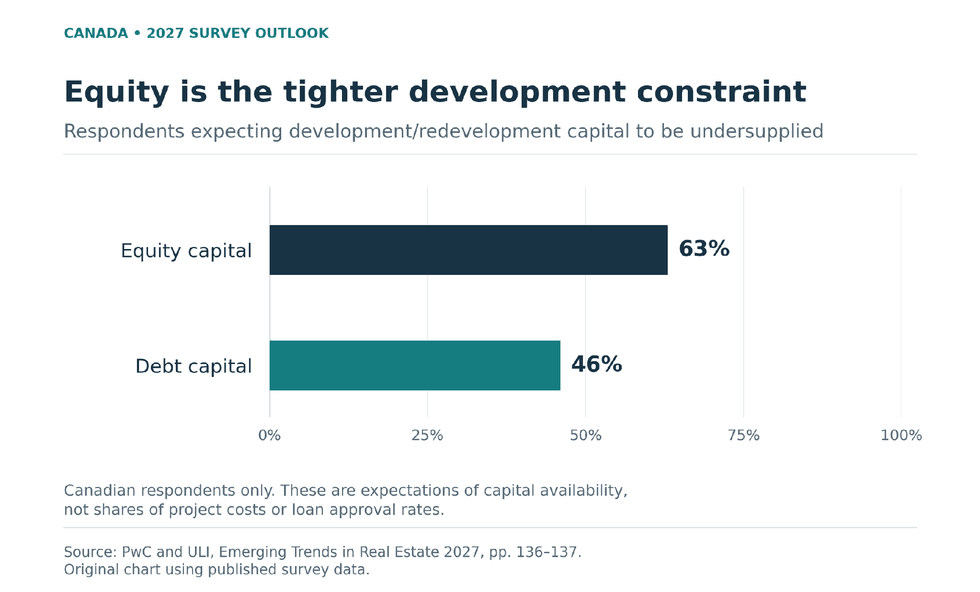 Canadian respondents were more likely to expect an undersupply of development/redevelopment equity capital (63%) than debt capital (46%) in 2027. These are survey expectations, not measured financing volumes. Source: PwC and ULI, Emerging Trends in Real Estate 2027, pp. 136–137. Original chart.
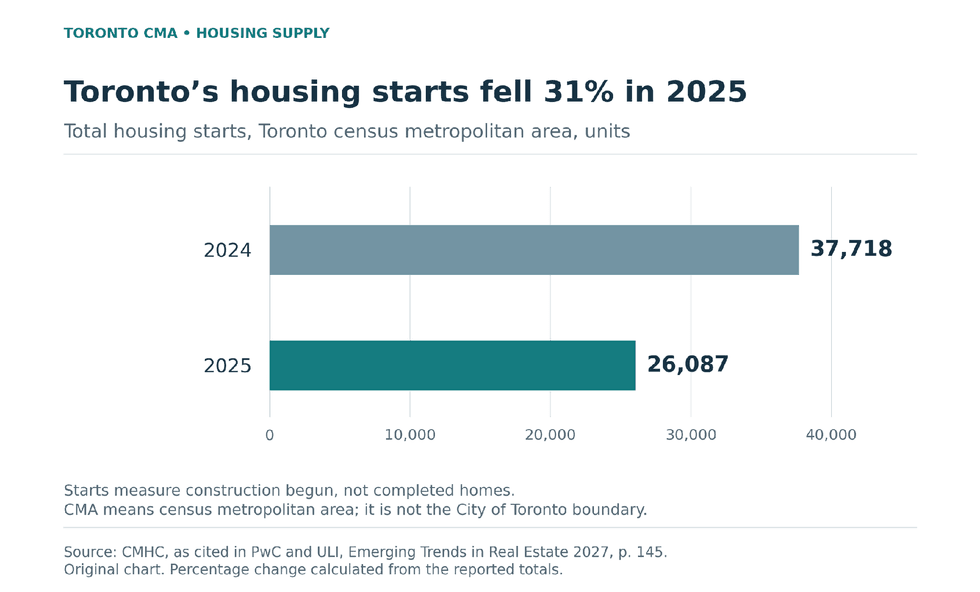 Toronto census metropolitan area housing starts fell from 37,718 units in 2024 to 26,087 in 2025, a 30.8% decline (rounded to 31%). Starts measure construction begun, not completed homes. Source: CMHC, as cited in PwC and ULI, Emerging Trends in Real Estate 2027, p. 145. Original chart.









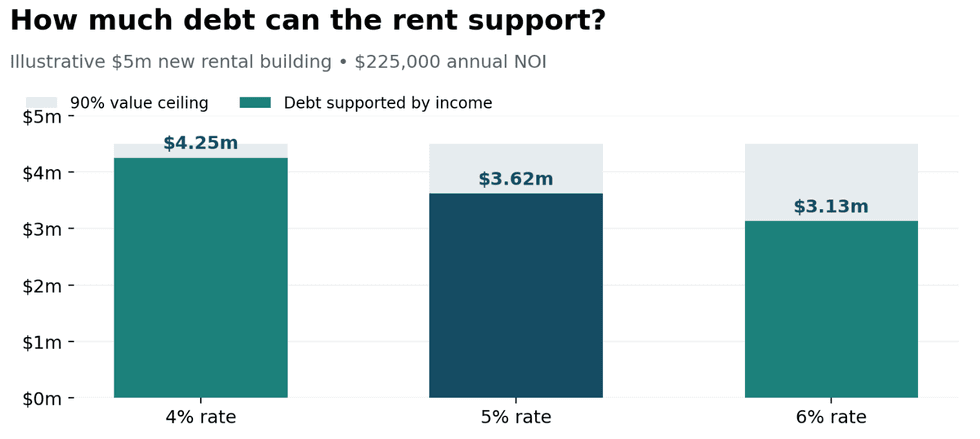 Illustrative calculation: a $4.5-million value ceiling versus income-based capacity of about $4.25 million at 4%, $3.62 million at 5% and $3.13 million at 6%. Assumes 50-year amortization and 1.15 debt coverage.
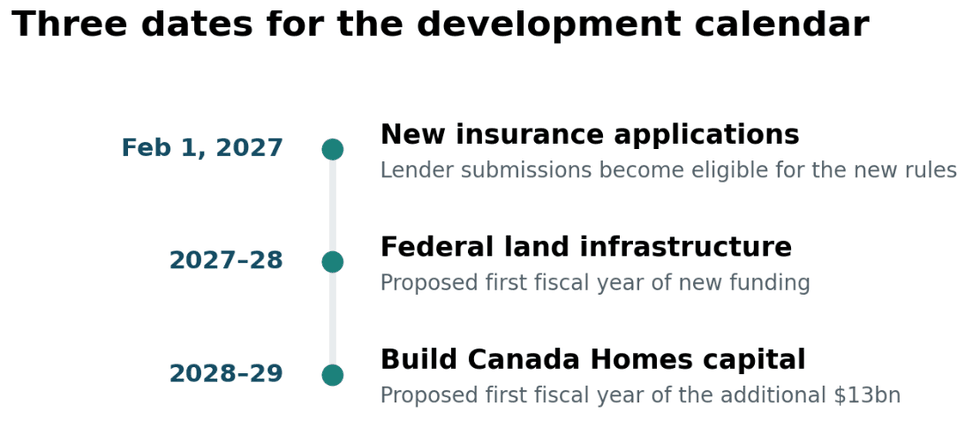 Source: Department of Finance missing-middle backgrounder and Budget 2026 Chapter 3, November 5, 2026. Fiscal-year funding starts are not home-completion dates.