About six months after publishing their 2026 Housing Market Outlook, the Canada Mortgage and Housing Corporation (CMHC) says that what was already a weak housing market has actually proven even weaker than expected.
“Housing market activity in 2026 has so far been weaker than expected, particularly in sales and prices,” said CMHC in its Summer Housing Market Update.
Housing prices are continuing to adjust — downward — to weak demand, and CMHC says they expect prices to continue declining through the rest of the year, but the improved affordability has not been enough to bring buyers back into the market in any significant way, and buyers are still acting with caution.
There also remains many headwinds, such as the continued economic uncertainty, high mortgage rates, and slow income growth.
Market conditions somewhat vary by region, with the Prairies and Quebec markets seeing momentum, but British Columbia and Ontario — the two largest real estate markets in Canada — are struggling and seeing “historically weak sales levels.”
The aforementioned factors, in conjunction with slower population growth, are also weighing on new construction.
“Housing starts are expected to decline further as builders continue to respond to unsold inventories and high construction costs,” said CMHC. “Historically low levels of construction will be most visible in Ontario and British Columbia, particularly in the condominium market. Housing starts in the Prairies and Quebec will also decline, but from recent peaks.“
The rental market has also been impacted, with starts easing from last year’s historic peak but still increasing at strong rates as developers shift from condos to rentals en masse.
“National rental markets should continue easing in 2026,” said CMHC. “New supply is increasing, especially from purpose-built rental projects. This will help lift vacancy rates and slow average rent growth, particularly for asking rents. This easing is more noticeable in larger markets such as Toronto and Vancouver, which are more affected by slower population growth and a larger supply of condominiums in secondary rental markets.”
Updated Forecasts
CMHC also published updated housing market forecasts, which include some notable differences between Greater Vancouver and Greater Toronto.
In terms of housing starts, Vancouver totalled 28,112 starts in 2024 and 27,185 in 2025, while this year is projected to be between 26,000 and 27,000. That would represent a decline from previous years, and the decline is expected to continue, with between 21,900 and 25,100 starts projected for 2027 and between 20,500 and 22,000 projected for 2028. Toronto, however, is expected to trend in the other direction, with the 2026 total expected to be similar to Vancouver, and then projected to increase thereafter.
A similar trend is expected for their respective resale markets. Vancouver recorded 35,671 home sales in 2024 and 30,780 in 2025, but 2026 is projected to finish between 28,000 and 28,800. Improvement is expected in the years to come, with projections of between 29,800 and 32,200 sales in 2027 and between 28,800 and 32,800 in 2028. Toronto, however, is expected to see a much larger improvement, jumping from between 63,000 and 63,500 this year to between 69,500 and 71,500 in 2027 and between 75,200 and 77,000 in 2028.
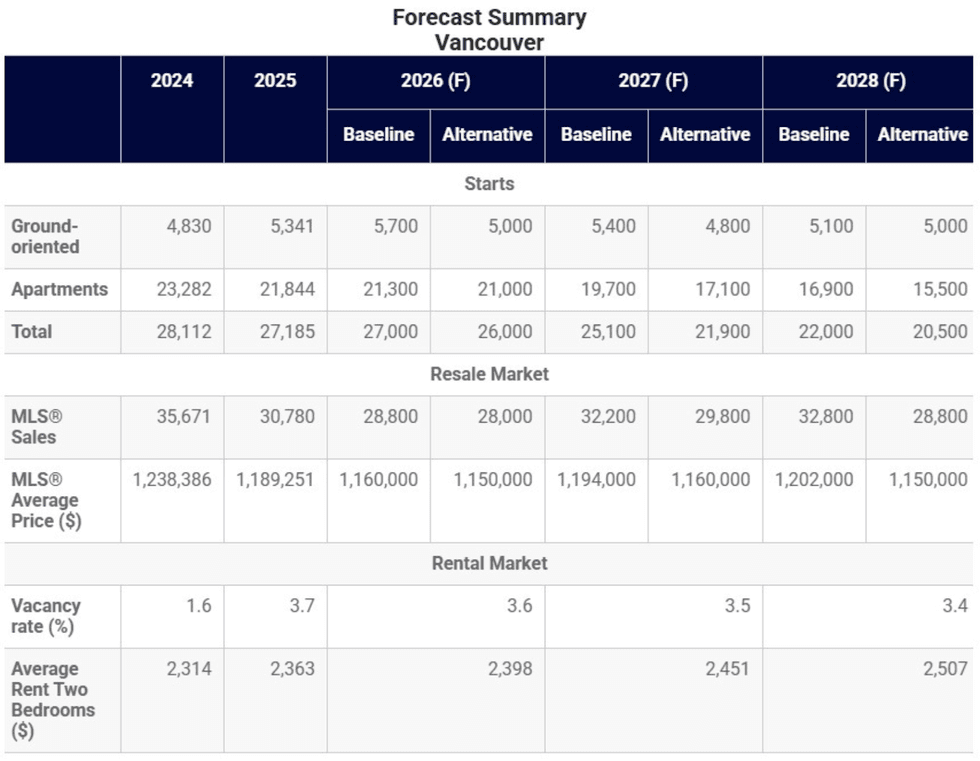
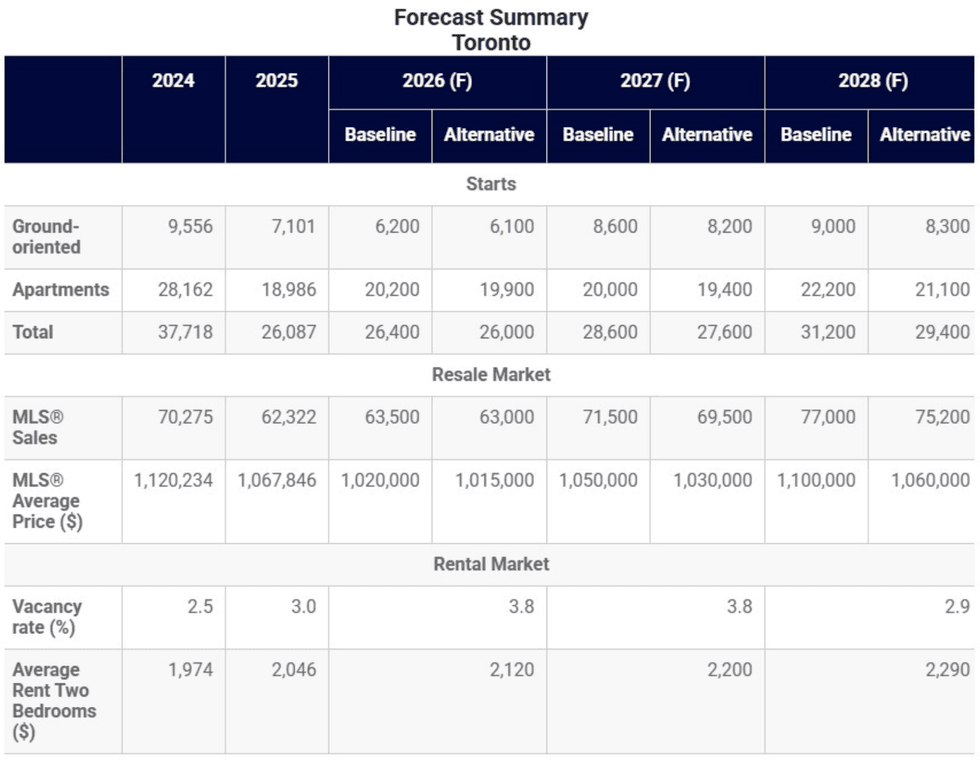 Housing market forecasts for Vancouver and Toronto. (CMHC)
As for the rental market, Vancouver ended 2025 with a vacancy rate of 3.7% and CMHC is expecting a decline to 3.6% after this year, to 3.5% in 2027, and then 3.4% in 2028, with average rents projected to growth by about $50 each year. In Toronto, the vacancy rate is expected to jump from 3.0% last year to 3.8% this year, stay steady next year, then drop back down to 2.9% in 2028. (A vacancy of between 3% and 4% is typically considered healthy for Vancouver and Toronto.)
Economic Forecast
Much of these projections will, of course, be dependent on the economy, and unfortunately the uncertainty is sticking around.
“Uncertainty remains high throughout the forecast period,” said CMHC. “Global tensions, especially the US-Iran war, will likely push inflation up temporarily in 2026. Ongoing US-Canada trade uncertainty will likely weigh on business investment and hiring decisions.”
CMHC is still expecting a modest 0.7% growth in 2026, with differing nuances for different regions.
“Western Canada is expected to lead growth in 2026, helped by stronger commodity prices resulting from the US-Iran war,” said CMHC. “Central Canada is more affected by trade risks and is likely to lag. Conditions in Atlantic Canada remain the weakest.”
Economic growth is not expected to pick up until after 2027, but even then it is expected to be moderate, although the differences between the regions is expected to narrow due to more diversified trade and increased business investment.
“These economic conditions set the backdrop for the housing market outlook in Canada,” said CMHC.