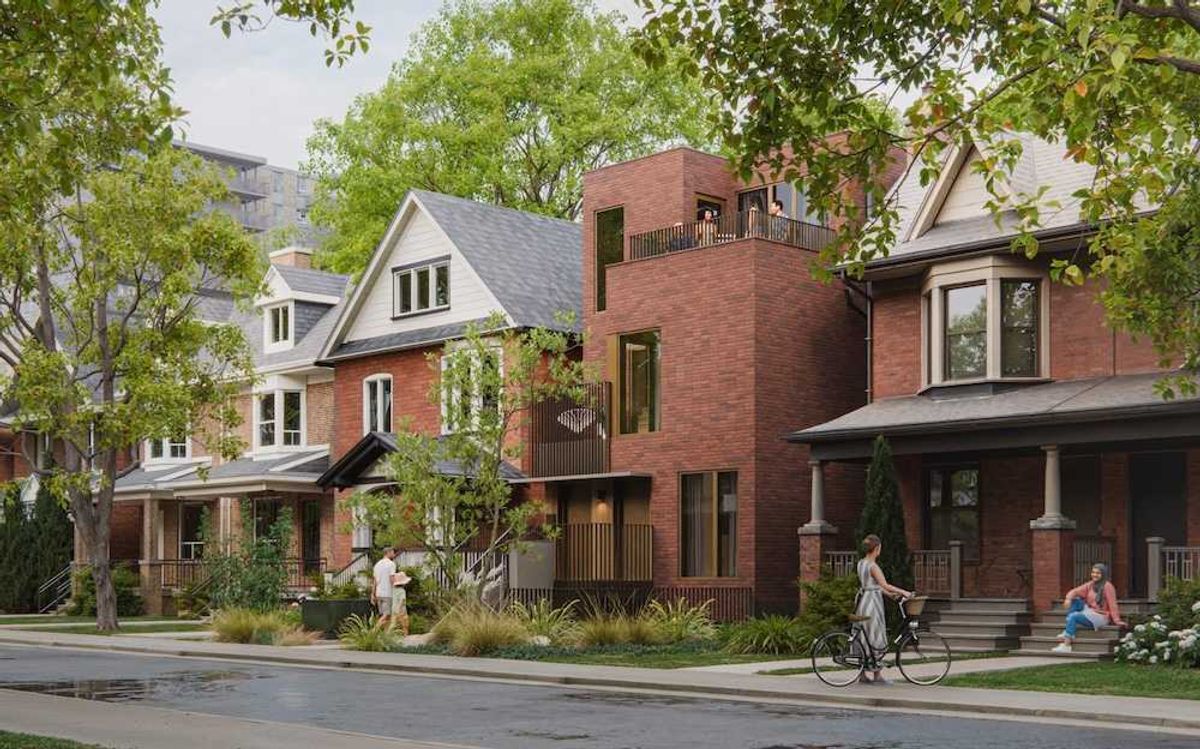
Small-scale infill projects have gone from a barely noticeable share of Toronto’s housing starts to a more meaningful one in just two years, according to a new analysis from Canada Mortgage and Housing Corporation (CMHC). Last year, smaller infill projects — accessory dwelling units and buildings with two to eight units — accounted for 6.45% of the city’s total housing starts, and while that figure may seem slight, it’s up more than tenfold from 0.62% in 2023.
The growth of small-scale infill has been particularly pronounced in a handful of other Canadian cities. In Vancouver, these projects accounted for 18.07% of total housing starts in 2025, up from 13.22% in 2023. Edmonton saw an even larger increase, from 9.95% to 23.28% over that two-year course. CMHC describes Calgary as also having ”strong growth in small-scale infill.”
“Uptake has been slower in Ontario overall, partly reflecting weaker housing starts in recent years,” the national housing agency says. “However, in places like Toronto, small-scale infill starts have still increased even during an overall slowdown.”
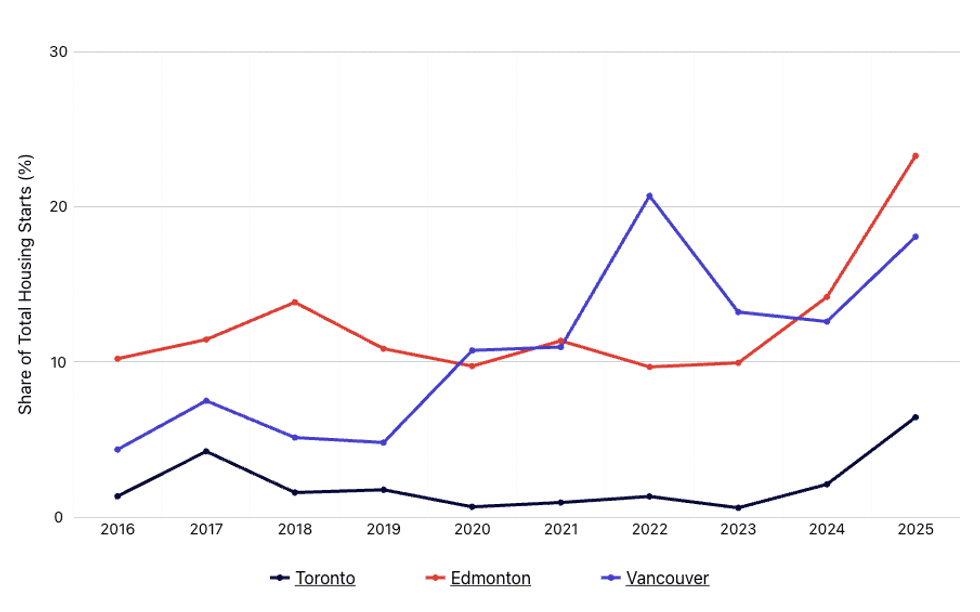 Small-scale infill share of housing starts in Toronto, Vancouver, and Edmonton/CMHC
In a separate analysis from last year, CMHC noted that residential-to-residential infill conversions have actually become the leading form of “missing middle” housing development in Toronto.
“Limited availability of undeveloped land makes gentle density through infill development a necessity,” said CMHC. “Notably, during the first half of 2025, there were over four times as many units initiated through conversion than there’ve been combined single- and semi-detached starts on new foundations. Unlike high-rise construction, which is concentrated in the downtown core, infill conversions are happening across the city.”
Recent zoning reforms have made these types of projects more common. In May 2023, Toronto City Council approved as-of-right permissions for multiplexes of up to four units — a move that paved the way for duplexes, triplexes, and fourplexes in areas where they were previously restricted. The city has continued to expand its multiplex permissions since, and today, as-of-right allowances for five and sixplexes have been extended to nine out of 25 wards.
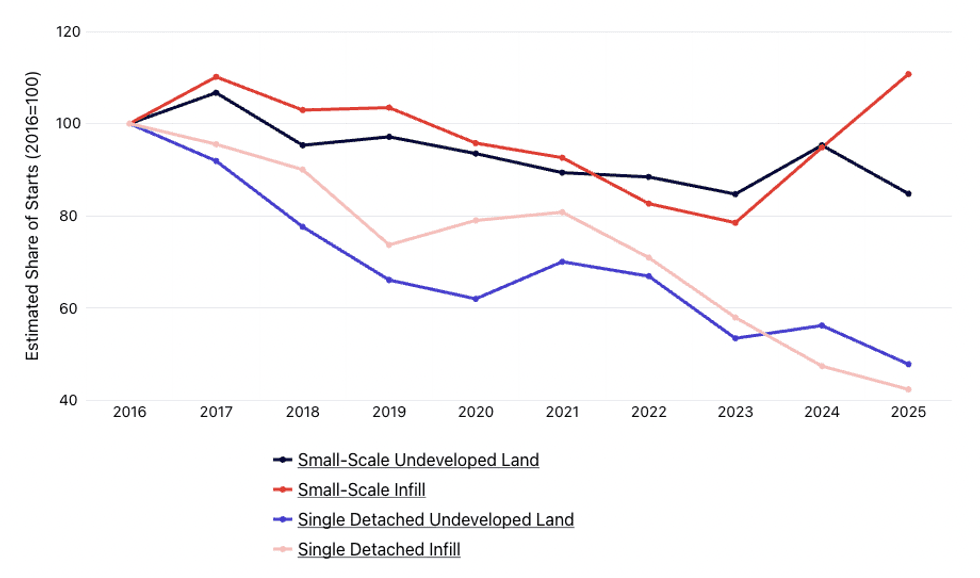 Housing starts for one to eight unit developments/CMHC
The regional growth in small-scale infill is in line with a nation-wide shift in how new housing is being delivered. CMHC estimates that small-scale infill accounted for around 10% of Canada’s total housing starts last year. Single-detached housing starts have been falling since 2016, but the uptick in small-scale infill has managed to make up for at least some of the decline.
“Its share of total housing starts was falling until about 2023, before rising sharply to surpass 2016 levels,” says CMHC. “The timing of this reversal coincides with the launch of the Housing Accelerator Fund, as well as municipal and provincial reforms, such as Bill 23 in Ontario, and Bill 44 in British Columbia. Together, these changes allowed more small-scale infill housing to be developed on lots that historically contained a single home.”
Though the growth of small-scale infill is notable, the predominant form of infill is Canada has long been larger in scale. CMHC estimates that infill developments with nine units or more accounted for 63% of national housing starts last year, driving the share of total starts on previously developed land up to 60.17%. A decade earlier, those figures were 42% and 54.5%, respectively.