A developer who shelved a small rental project over financing has a reason to price it again.
Budget 2026 gives newly built triplexes and fourplexes access to insured loans of up to 90% of completed value. It also lets private insurers cover buildings with five to 50 units.
Budget 2026, tabled November 5, pairs those changes with more money for Build Canada Homes. For a smaller builder, the mortgage rules are the part to take to a lender first: how much cash would the project need up front, and could the finished building support the loan?
Keep the rent assumptions where they were for that comparison. Otherwise, it becomes hard to tell whether the financing has improved the project or the spreadsheet has simply become more optimistic.
Different rules on either side of five units
The Department of Finance's technical rules take effect for insurance applications lenders submit on or after February 1, 2027. The unit count determines which rules apply.
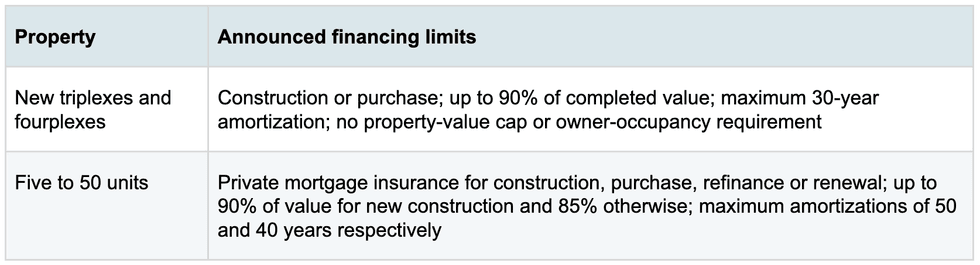
For buildings with five to 50 units, term financing requires a minimum debt coverage ratio of 1.15 for a five-year term or 1.10 for a ten-year term. Borrowers need net worth equal to at least 25% of the requested loan, with a $100,000 minimum, based on Canadian assets. Separately titled properties cannot be bundled to meet the unit requirement.
Construction loans are assessed separately. Insurers set their own debt-servicing criteria during construction; the prescribed amortization and debt coverage requirements apply to term financing. Borrowers using the new three- and four-unit option also have to pass personal qualification tests for the long-term mortgage.
A fourplex and a six-unit building can face quite different borrowing limits on the same site. The six-unit design may qualify for a longer amortization, but it may also cost more to build. Compare the extra debt with the extra cost and rent before choosing the larger project.
Compare the new loans with CMHC
CMHC Standard Rental Housing already covers eligible properties with at least five units. It allows borrowing of up to 85% of value, with amortizations of up to 50 years for new construction and 40 years for existing properties.
MLI Select offers different terms in exchange for commitments to affordability, energy efficiency or accessibility. Eligible new construction can qualify for up to 95% loan-to-cost, depending on the points earned and the program's other requirements.
The new private-insurer rules add another option to that comparison. Be careful with the percentages: 90% of appraised value and 95% of project cost can produce quite different loan amounts.
Ask for offers that cover the same project and construction schedule. Compare the interest rate and insurance premium, then work through guarantees, reserve requirements and conditions on each draw. A larger approved loan can be less useful if its costs are higher or the money arrives too late to pay the contractor.
The rent limits the loan
Take a hypothetical new rental building worth $5 million, with annual net operating income of $225,000. At a 5% mortgage rate, a 50-year amortization and 1.15 debt coverage, the income supports about $3.62 million of debt. A loan at 90% of the building's value would be $4.5 million.
That leaves a gap of roughly $881,000 between the advertised maximum and what the income can support.
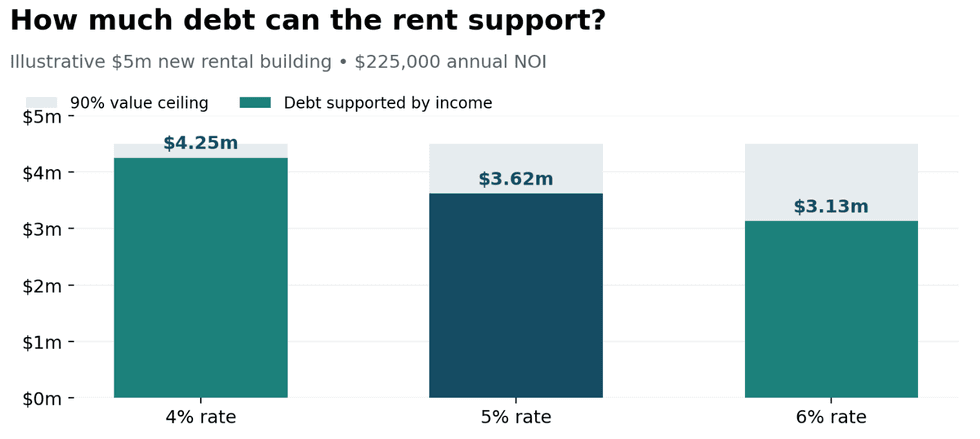 Illustrative calculation: a $4.5-million value ceiling versus income-based capacity of about $4.25 million at 4%, $3.62 million at 5% and $3.13 million at 6%. Assumes 50-year amortization and 1.15 debt coverage.
These calculations apply to the mortgage after construction. They use monthly payments and Canadian nominal rates compounded semi-annually, and exclude insurance premiums, fees and reserves. The rates are examples rather than lender quotes. An insurer may also use different income and expense assumptions when it assesses the property.
A builder can tie up less equity and still be taking on more risk. The loan has to be serviced through vacancies, repairs and a slower-than-expected lease-up. Those expenses belong in the operating budget before anyone calculates how much debt the building can carry.
Get the construction loan and the permanent mortgage assessed together. If the finished property cannot support enough mortgage debt to repay the construction lender, the builder has to find the difference.
Build Canada Homes funding starts later
The budget proposes another $13 billion in cash capital for Build Canada Homes over ten years, beginning in 2028–29. That would bring its capitalization to $45 billion. Ottawa's target is 200,000 homes over the next decade; delivery will depend on projects moving through approvals and construction.
It also proposes $1.5 billion over four years from 2027–28 for infrastructure on federal land, plus $387.4 million in later years. A builder considering a partnership needs to know when a particular site will be serviced and when the money will be available. Procurement terms will determine who can take part.
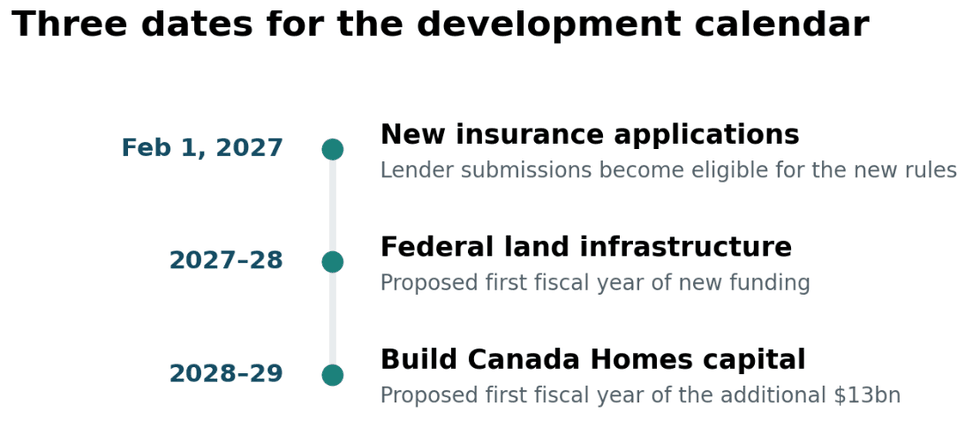 Source: Department of Finance missing-middle backgrounder and Budget 2026 Chapter 3, November 5, 2026. Fiscal-year funding starts are not home-completion dates.
Public land and long-term capital can help build housing for people whose rents cannot cover the cost of new construction. The operating budget needs funding, too. Taxes, maintenance and repairs continue long after the building opens.
For market rental projects, the effect will depend partly on the supply of buildable sites. Easier financing can help developers start viable projects. Where land and approvals are scarce, buyers may instead use the extra borrowing room to bid more for the same sites.
Reprice the project before bidding more for land
Run the available financing options against the same operating budget. Then confirm which lenders and insurers will offer them, what they need to approve an application and how the construction loan converts to a term mortgage. February 1 is the start date for lender submissions, so allow time for approval and funding.
For a small developer, the useful result is a loan commitment that makes a viable project possible.
If the numbers work only after raising the projected rents or cutting the repair allowance, the financing problem is still there.