A better loan offer won't get a stalled project built if nobody is willing to put up the equity.
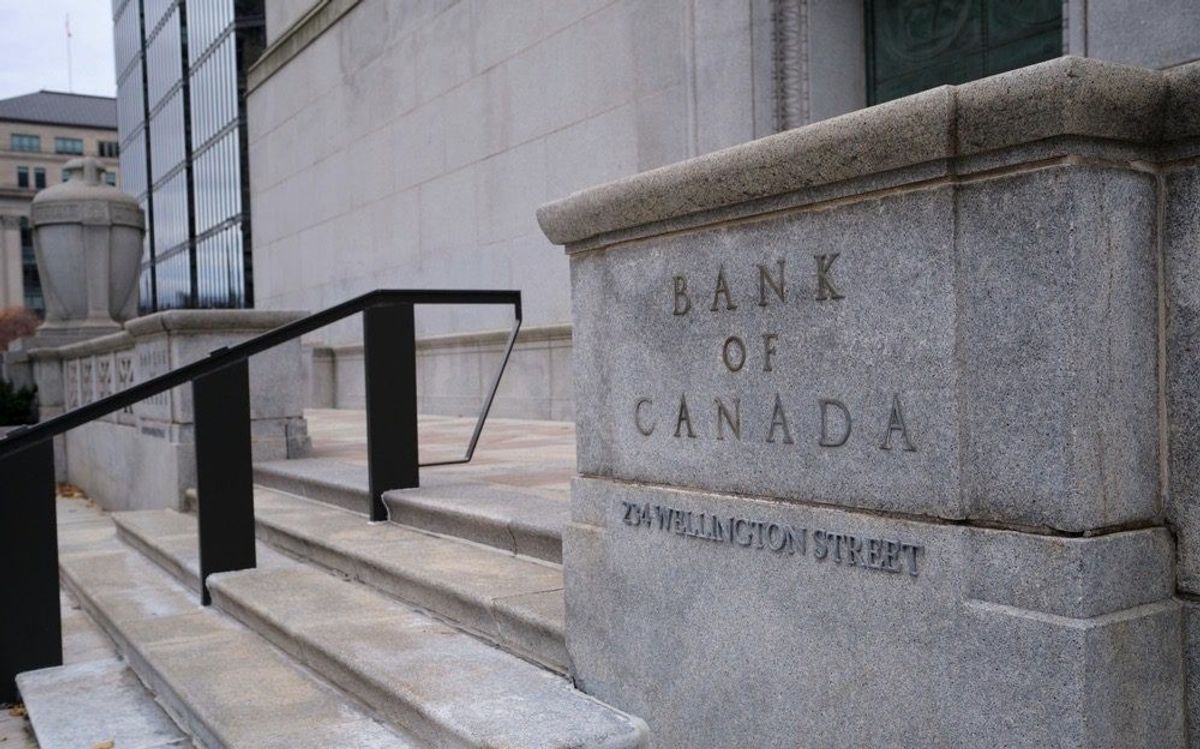
That problem runs through PwC and the Urban Land Institute's Emerging Trends in Real Estate 2027. Among Canadian survey respondents, 63% expect equity for development and redevelopment to be undersupplied in 2027. For debt, the figure is 46%. These are views on capital availability, not financing rejection rates. Even so, they put a limit on how much optimism developers should take from a recovery in dealmaking.
Cheaper or more available debt helps. The developer still needs an investor willing to fund the rest.
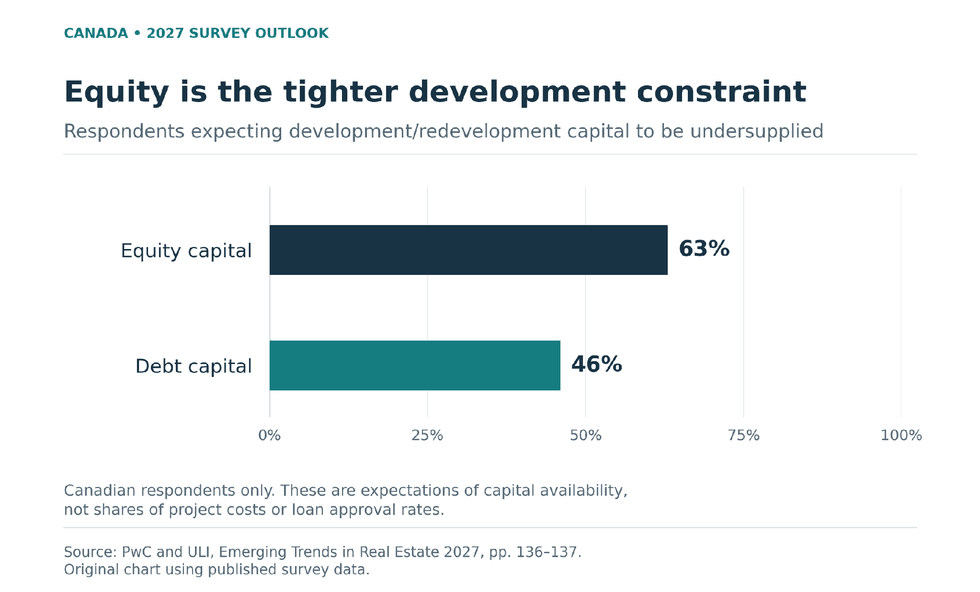 Canadian respondents were more likely to expect an undersupply of development/redevelopment equity capital (63%) than debt capital (46%) in 2027. These are survey expectations, not measured financing volumes. Source: PwC and ULI, Emerging Trends in Real Estate 2027, pp. 136–137. Original chart.
More deals do not necessarily mean more construction
Canadian commercial real estate investment reached $16.2 billion in the second quarter of 2026, according to the CBRE figures cited in the report. That was the strongest quarter since early 2022. The total includes mergers and acquisitions, so a few large transactions can do a lot of the lifting. It tells us money is moving again, without telling us how broadly the recovery has spread.
There is also a practical reason an investor might buy an existing building before funding a new one. An occupied property already collects rent. A development can spend years consuming cash before the first tenant moves in.
The buyer of an existing building can negotiate the price down. A developer has to work with the cost of delivering a new one. Construction and servicing bills don't fall just because the building down the street sold at a discount.
That leaves room for a busy acquisitions market and a weak construction market at the same time. Investors can buy assets from struggling owners without financing the next round of projects.
Some of those sales will help. A new owner may have the cash to finish a stalled building, or a lower purchase price may finally make the numbers work. The test is whether construction follows the transaction.
Toronto is already starting fewer homes
The report puts Toronto census metropolitan area housing starts at 26,087 in 2025, down from 37,718 in 2024, citing CMHC. That is 11,631 fewer homes started in a year, a decline of about 31%. These are historical construction starts, not a prediction of how many homes will be finished in 2027.
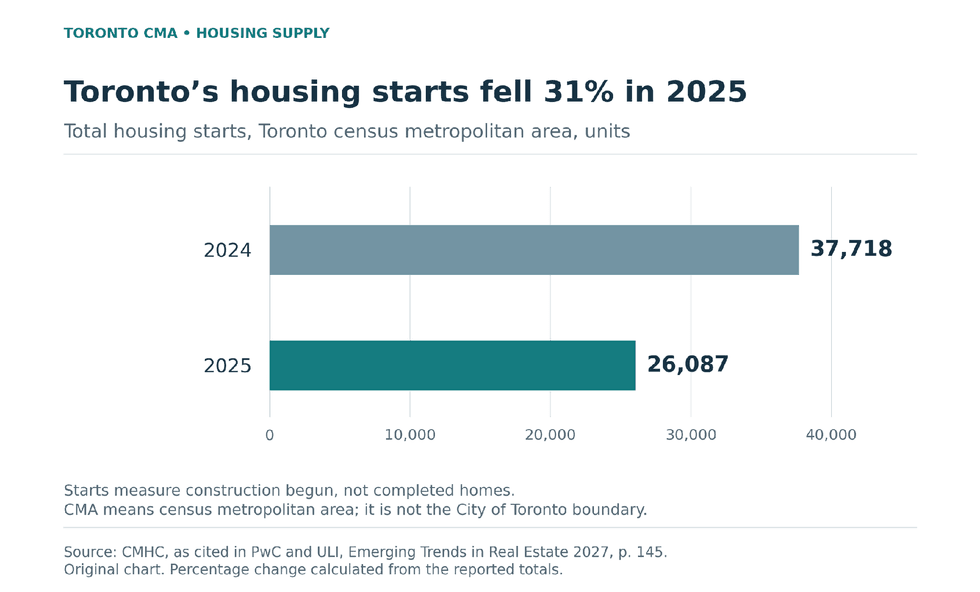 Toronto census metropolitan area housing starts fell from 37,718 units in 2024 to 26,087 in 2025, a 30.8% decline (rounded to 31%). Starts measure construction begun, not completed homes. Source: CMHC, as cited in PwC and ULI, Emerging Trends in Real Estate 2027, p. 145. Original chart.
A thinner construction pipeline gives developers a reason to expect less competition when their buildings open. It can be a sound argument for buying a site. It is a much harder argument to make to an investor who needs their money back before the project is ready.
In the meantime, the carrying costs keep coming.
A partner willing to wait through a slow lease-up gives a project more room than one counting on an early sale. Both can believe Toronto needs more housing. They still need to agree on how long they can afford to wait for the income.
A rental conversion needs a new business plan
The report describes continued long-term interest in purpose-built rental. Some interviewees are much less convinced that today's rents can cover the cost of building and financing it. Both views can be reasonable.
Changing a condo proposal to rental means rewriting the business plan. The developer gives up the expected proceeds from individual suite sales and collects rent over years instead. The design and financing have to support that longer commitment, including the cost of running the building.
Start with the rent a tenant will actually pay. If a competing building offers free months, its advertised rent overstates what the landlord collects over that lease. Using that advertised rent as a comparable can overstate the income the new project will collect.
Then check how long it will take to fill the building. Reaching the target rent six months late can still leave the owner short of cash. The partners need to know who covers that shortfall before the first bill arrives.
The next equity cheque may go into an old building
Loans coming due in 2027 will compete for that money too. PwC and ULI describe owners using preferred equity, mezzanine financing and joint ventures to close funding gaps.
If a replacement loan is smaller than the debt being repaid, the borrower has to make up the difference. That can mean putting cash into a building they already own instead of buying the next site.
The terms deserve as much attention as the amount raised. Preferred returns and fees can leave less income for the original owner. Repayment deadlines can force decisions well before that owner intended to sell. A refinancing that solves today's shortage may leave very little room for the next delay.
Before committing more money, a developer should know which assumption the project can least afford to get wrong. If a small rent reduction or a few extra months of vacancy wipes out the return, a higher exit value in the spreadsheet is doing too much work.
Housing policy has to deal with those gaps too. A fee reduction helps if it brings the cost within reach of the revenue a project can earn. A financing program helps if it supplies money on terms the project can carry. The evidence of success is a financed project that starts construction.
The report gives developers a reason to call investors again. Those calls still have to end with an agreement on the equity and how long it can stay in the project. Until then, a recovery in transactions offers limited comfort to the owner paying to hold an empty site.