I have lost count of how many times I have heard that Toronto and Vancouver are a special case. Too expensive, too much debt, a local hangover. October is getting in the way of that story.
In CREA's residential numbers, Greater Toronto sales were down 7.9% from last October. Greater Vancouver was down 10.7%. Calgary was down 12.8%. Ottawa was down 10.8%. Montreal was down 17.6%. The country was down 10.6%. If those two cities were still a quarantine zone, the others would not be on that list.
Prices have not followed in every market, and that is the part worth sitting with. Calgary's benchmark was unchanged at $569,300. Montreal's was still up 1.4%, to $591,400. Ottawa was only down 1.5%. Toronto is down 4.4% on the year and 13.7% over three years. Vancouver is down 5.2%. Volume goes first. Price lags. Then the "isolated incident" starts to look like a leading indicator.
Two provinces, opposite directions
That national demand story sits on top of a supply split I still think is the more interesting chart in this release. Ontario recorded 33,510 new residential listings in October, 8.8% fewer than a year ago, against 14,053 sales, down 8.7%. Quebec went the other way on supply: 13,864 new listings, up 6.2%, against 7,451 sales, down 12.6%. Ontario's new listings have run below year-ago levels for essentially all of 2026. Quebec's have run above.
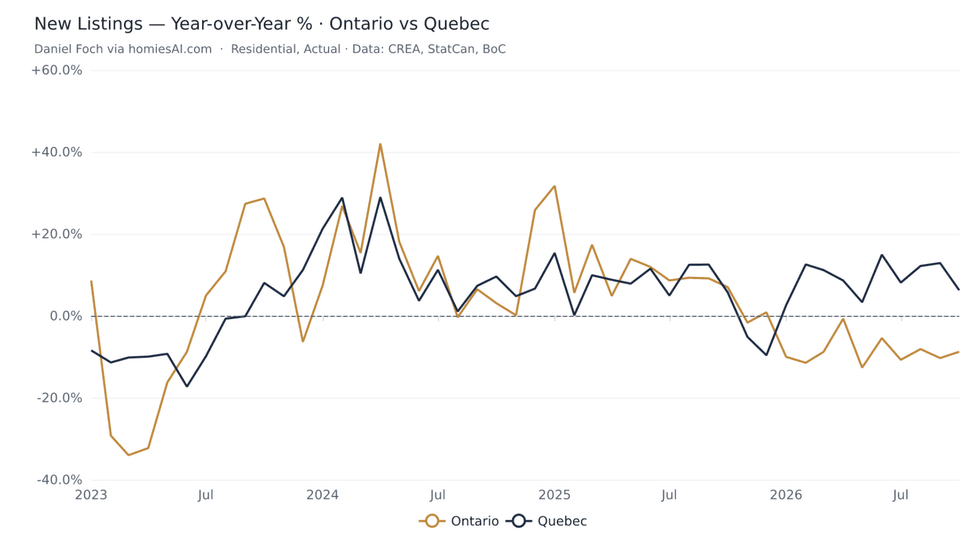 Chart: New listings, year-over-year %, Ontario vs Quebec. Daniel Foch via homiesai.com/stats. Data: CREA.
The Greater Toronto benchmark is $928,800, down 4.4% year over year. Mississauga is down 8.5%. Quebec CMA is up 5.1%, and 33.6% over three years. Ontario is tightening the shelf and still losing price. Quebec is adding listings and still gaining some.
Toronto tightened by subtraction
Through the first ten months of 2026, the Greater Toronto Area logged 145,345 new listings, 14.7% fewer than the same period last year. Sales were 52,694, down only 1.8%. The year-to-date sales-to-new-listings ratio rose to 36.3% from 31.5%.
That "improvement" came from sellers stepping back. Buyers did not arrive. Even after a year of withdrawals, Toronto's seasonally adjusted ratio was 39.1% in October, still under the 45% floor of CREA's balanced range.
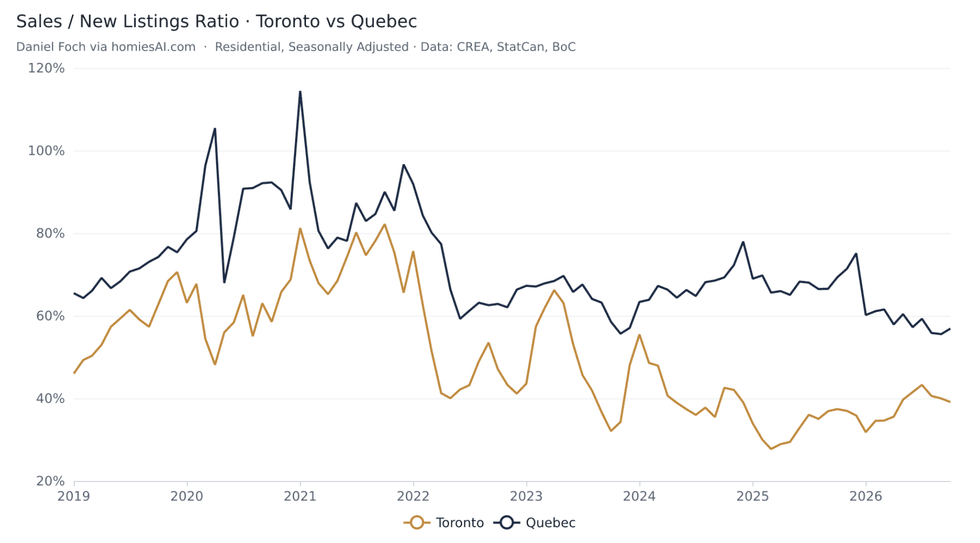 Chart: Sales-to-new-listings ratio, seasonally adjusted. Toronto vs Quebec. Daniel Foch via homiesai.com/stats. Data: CREA.
Montreal moved the other way. Year-to-date new listings rose 6.3% to 69,458 while sales fell 8.7% to 37,091, pulling the ratio down to 53.4% from 62.2%. Montreal is loosening from a seller's market toward balance. Toronto is crawling up from a buyer's market by shrinking the choice set.
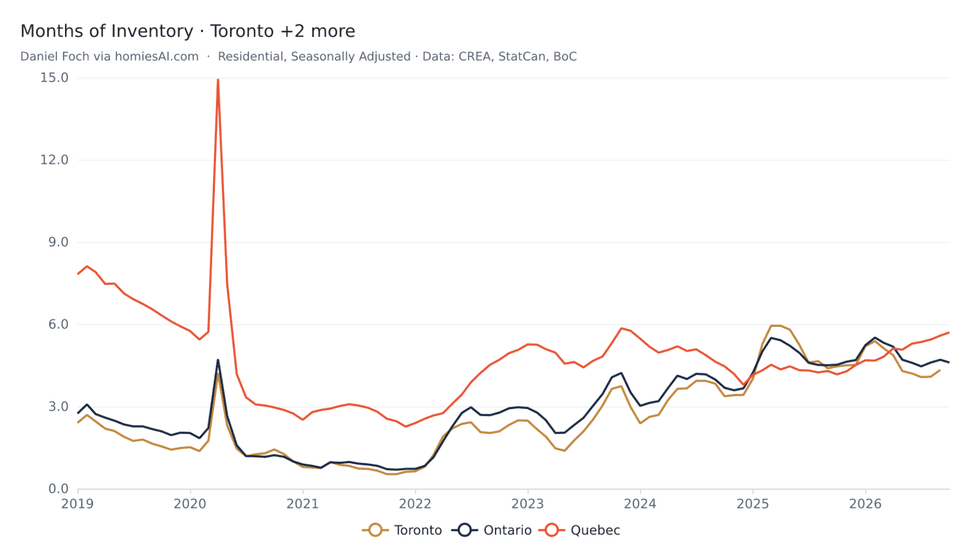 Chart: Months of inventory, seasonally adjusted. Daniel Foch via homiesai.com/stats. Data: CREA.
I would not tell a Quebec builder the Ontario correction has landed in Montreal prices. I also would not tell them demand is insulated. Montreal sales were down 17.6% in October, in a market where prices are still rising. Some of that is rates. Montreal's benchmark sits about $337,000 below Toronto's, so a hike bites less than it does on a GTA loan. Some of it, in my view, is confidence and equity travelling. When Toronto and Vancouver values fall, owners feel poorer. They spend less and they move less. Investors who hold product in more than one city get careful. Lenders do too. I cannot show you a contagion index. I can show you volumes weakening in places that were supposed to be fine.
The pipeline tells the longer story
Resale listings are this month's supply. Housing starts are the supply of 2029 and 2030.
From January through September 2026, Ontario's housing starts averaged a seasonally adjusted annual rate of about 61,200, according to CMHC data compiled on Homies stats. Quebec averaged about 60,100. Ontario's pace is down 5.7% from the same months of 2025. Quebec's is up 1.8%.
Those two numbers are nearly identical. The provinces are not. Statistics Canada estimates Ontario's population at about 16.26 million and Quebec's at about 9.07 million as of July 2026. Per 1,000 residents, Quebec is starting homes at an annualized pace of roughly 6.6. Ontario is at roughly 3.8.
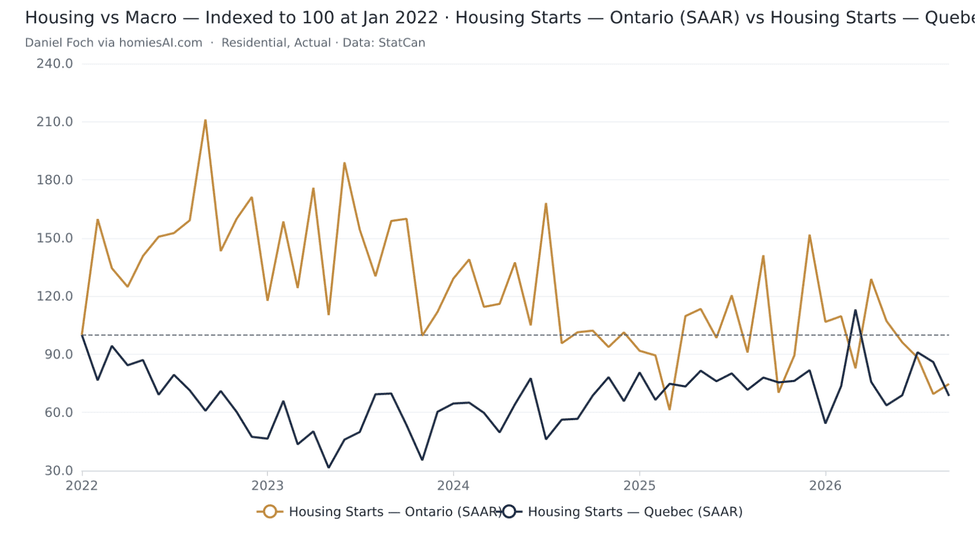 Chart: Housing starts, seasonally adjusted annual rate, Ontario vs Quebec, indexed to January 2022. Daniel Foch via homiesai.com/stats. Data: CMHC via Statistics Canada.
Ontario's resale market is reaching balance by holding product back. Its development pipeline is doing the same thing. If the demand softness in Toronto is a leading indicator rather than a local mess, that is a problem for anyone underwriting 2028 absorption in the rest of the country.
The condo collapse is a resale problem first
Nationally, condo starts from January through September totalled 25,719, down 34.8% from 39,446 in the same months of 2025. Purpose-built rental starts rose 8.6% to 90,623.
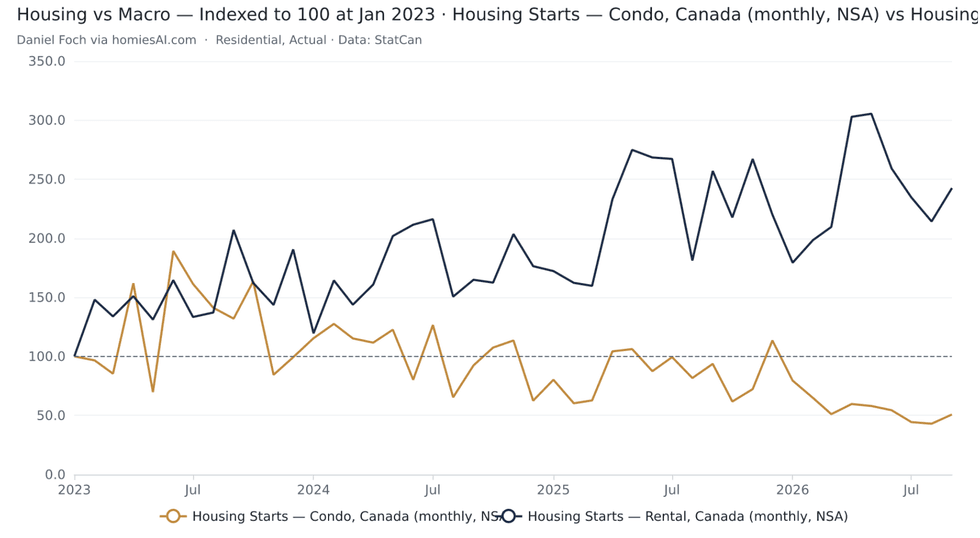 Chart: Condo vs rental housing starts, Canada, indexed to January 2023. Daniel Foch via homiesai.com/stats. Data: CMHC via Statistics Canada.
Presale condo projects need buyers willing to pay tomorrow's price today, and lenders need those presales before construction financing flows. When the GTA resale benchmark is down 13.7% over three years, the comparable undercuts the presale, the presales do not get sold, and the project does not start.
A rate hike makes that worse. The Bank of Canada raised the overnight rate to 2.50% from 2.25% on October 28, its first increase since July 2023. Then the five-year Canada bond, the thing lenders actually price a fixed mortgage off, jumped from 3.33% to 3.60% in under a week, as Robert McLister noted in the Financial Post on November 16. Buying power got tighter after the October deals were already written.
Confidence was not exactly roaring into that. The Bloomberg-Nanos Canadian Confidence Index was 50.98 for the four weeks ending October 30, below its long-term average of 54.65. The expectations index, which includes the outlook for the economy and property prices, sat at 47.77. Nik Nanos called it the slow lane. A presale buyer is being asked to commit years out, with their home equity worth less and their fixed rate already moving. Rental is holding up because its financing does not depend on those retail buyers in the same way. That is a real offset. It does not replace the ownership units a turned cycle will need.
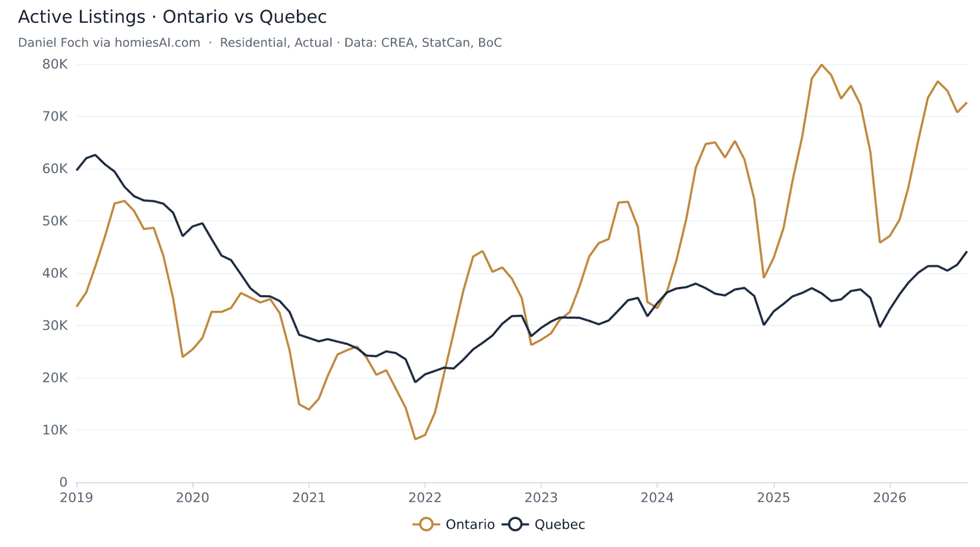 Chart: Active residential listings, Ontario vs Quebec. Daniel Foch via homiesai.com/stats. Data: CREA.
What it means
For builders: Quebec still has rising benchmarks and a ratio in balanced territory, which is the kind of comparable set that can support a presale. Ontario does not, and October's rate move does not help. I would not plan a national absorption number as if the demand problem stopped at the GTA border.
For policymakers: Ontario's resale "balance" is not proof the supply problem is solved. Sellers stopped listing. Builders stopped starting. Both are rational. Together they set up the next shortage. National inventory is about 197,000 listings, a little above CREA's long-term average of 190,000, with five months of supply. On paper, Canada looks balanced. Underneath, the biggest province is balancing by doing less, and the sales weakness that started in Toronto and Vancouver is no longer staying there. If we "solve" a glut by starting fewer homes, what does 2029 look like? The monthly CREA release will not answer that. The starts number might.