Of the 1,316 condominium apartments sold across the GTA in September, 893 sold for less than $600,000. Nearly half, 594 units, sold below $500,000.
That puts 67.9% of condo sales below $600,000 and 45.1% below half a million. For buyers trying to work out whether ownership is within reach, those transactions offer a more useful starting point than the GTA's $1,006,409 average price across all housing types.
The largest single condo price band was $400,000 to $499,999, with 390 sales. Another 299 apartments sold between $500,000 and $599,999.
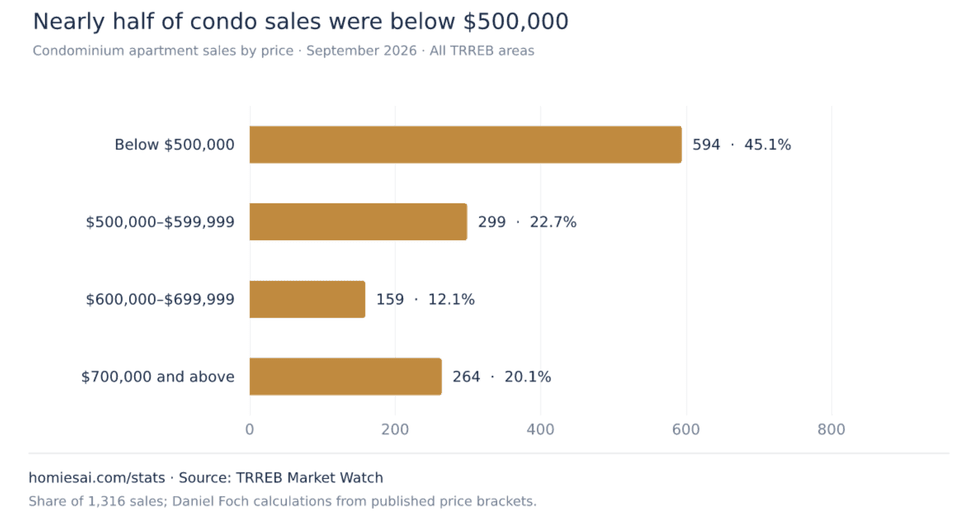
The table cannot tell a buyer whether a suitable two-bedroom apartment is available at that price in a particular neighbourhood. It covers the units that sold, with no adjustment for their size or location.
Prices fell faster than in the other major categories
The average condo apartment sold for $605,257 in September, down 7.7% from a year earlier, according to the Toronto Regional Real Estate Board's Market Watch report. That was the largest average-price decline among the four major housing categories in its summary table.
Detached prices fell 5.1%, the combined townhouse category fell 4.6%, and semi-detached prices were down 0.2%.
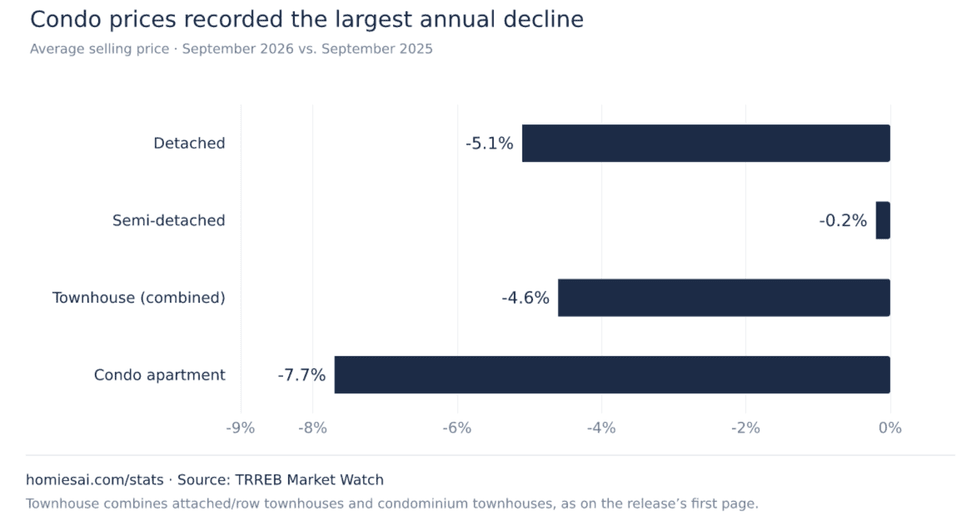
These are changes in the averages of homes sold, so shifts in the mix of properties affect the result. They do not mean every condo lost 7.7% of its value.
Condo sales totalled 1,316, down 7.8% from September 2025. Across all housing types, GTA sales fell 9% to 5,040. The weakness extended beyond apartments, but the condo market paired falling transactions with the steepest average-price decline in that four-category comparison.
The price decline was larger outside Toronto
The City of Toronto's average condo selling price was $640,248, down 6.1% from a year earlier. In TRREB's 905 category, which covers its reporting area outside the City of Toronto, it was $533,654, down 12%.
The $106,594 gap gives a buyer willing to change location a reason to compare apartments beyond Toronto's boundary. It is a difference between the units sold in the two areas; it does not measure the saving from moving an otherwise identical apartment into the suburbs.
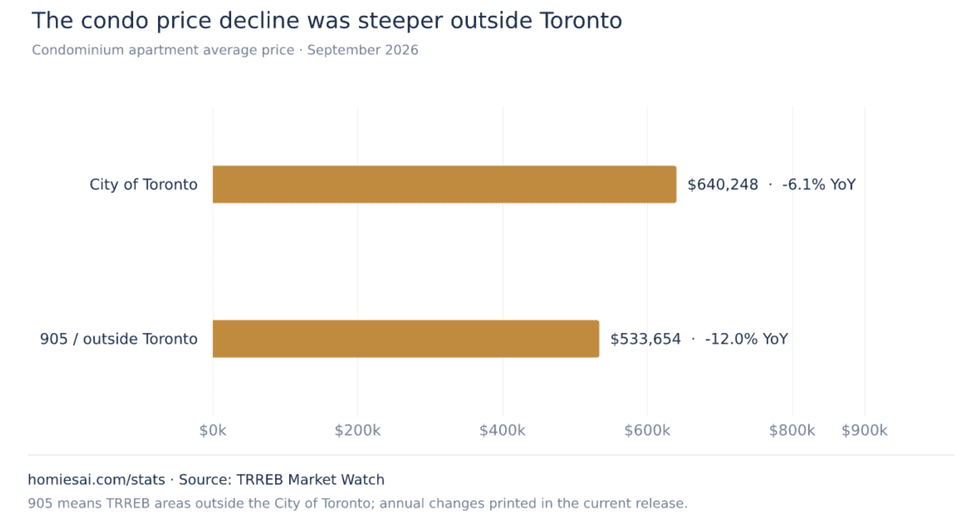
A lower purchase price also needs to be weighed against condominium fees and the building's finances. The report supplies selling prices, leaving the buyer to examine the obligations attached to each unit.
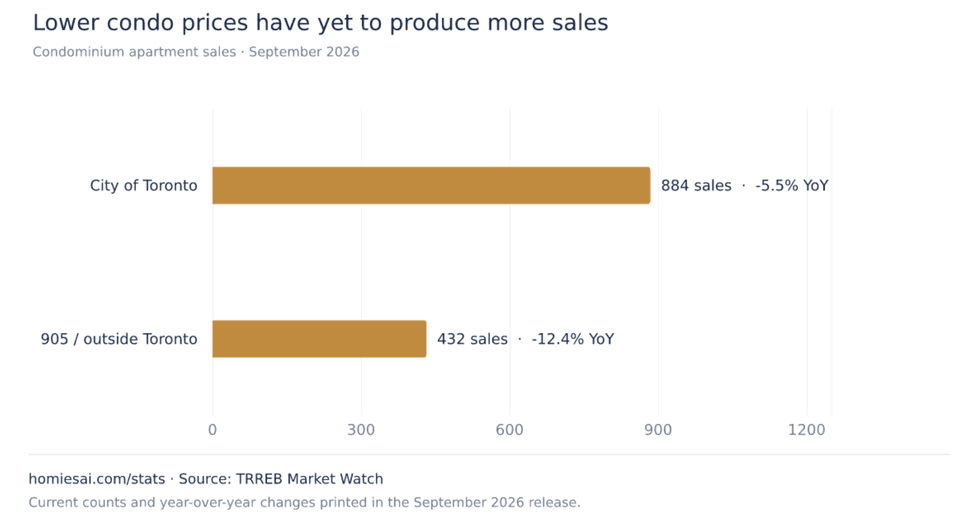
The cheaper 905 average coincided with a larger decline in sales. Toronto recorded 884 condo transactions, down 5.5% year-over-year. The 905 recorded 432, down 12.4%. Both areas offered lower average prices than a year earlier; neither recorded more sales.
The sales figures cannot establish why households held back. A developer counting on lower prices to lift transactions would need to look beyond September's result.
New condos have plenty of resale competition
At the end of September, 8,226 condo apartments were listed for sale across TRREB's coverage area. Of those, 5,329 were in Toronto and 2,897 were in the 905.
Dividing those month-end listings by September's sales produces ratios of 6.0 in Toronto and 6.7 in the 905. Each area had roughly six or seven apartments listed at month-end for every apartment sold during September.
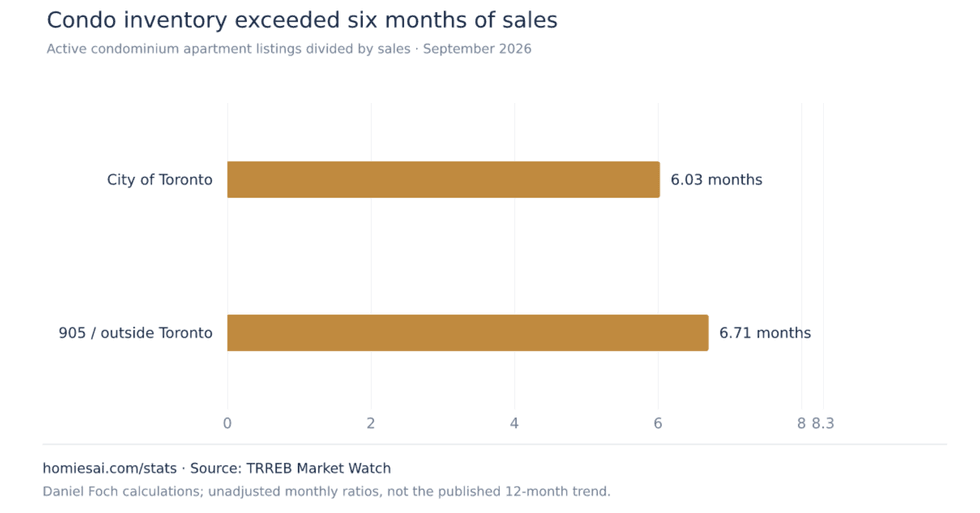
Properties arrive on the market and listings expire throughout the month, so this calculation compares available stock with one month's transactions. It differs from TRREB's published inventory trend measure and cannot forecast how long a particular unit will take to sell. Buyers have a selection of existing apartments to compare before committing.
For a new condominium project, those existing apartments are part of the competition. A prospective purchaser can compare the proposed unit's price and features with nearby resales. Any premium needs a reason that matters to that purchaser, such as a better layout or a location closer to work.
September's regional price bands do not set the correct price for a new unit. A small apartment in an older building is a poor comparable for a larger unit in a different neighbourhood. The bands do show where most completed condo purchases landed, which makes them a useful check on assumptions about the budgets a project will serve.
That check needs to include the total price. A unit can look competitive on a price-per-square-foot basis and still require a budget beyond what its intended purchaser can spend. Market Watch's price-band table does not include floor area, so it cannot resolve that comparison. It shows the total prices buyers agreed to pay.
Market Watch measures resales. It does not measure condo presales, construction starts, completions or developer finances. Those require their own evidence. A new project's price has to hold up against the resale units its target purchaser can afford today.
TRREB Market Watch September 2026 · Charts homiesai.com/stats. MLS® is a registered trademark of the Canadian Real Estate Association. This analysis is independent of TRREB and CREA.