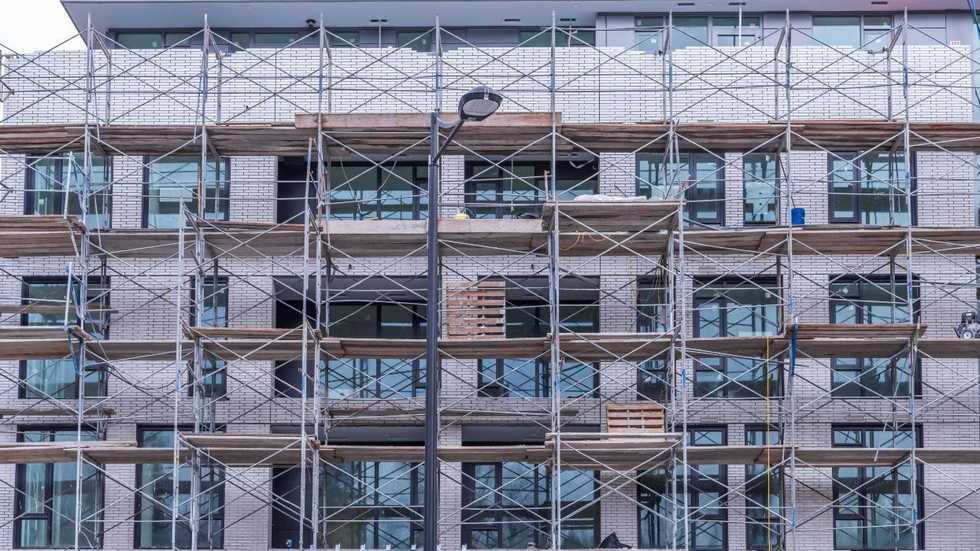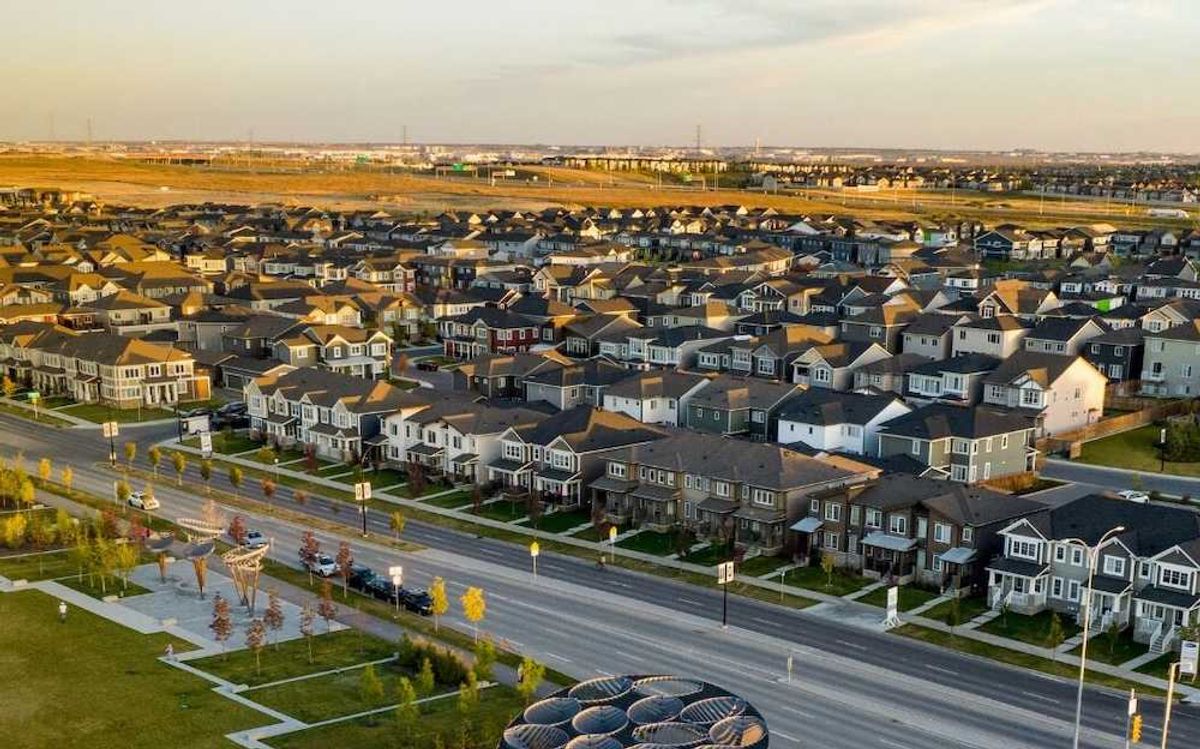
A builder has to sell tomorrow’s home against today’s resale market. When existing homes get cheaper, a new project has less room to cover its costs.
That calculation is becoming harder across much of Canada. CREA’s August figures show a national benchmark price 3% below a year earlier. Sales fell 6.9% from a year earlier, while new listings increased 3.3% from July after seasonal adjustment. Buyers gained choice without having to compete with a growing pool of purchasers.
The near-term benefit is clear. A household shopping for an existing home has more scope to negotiate. The longer-term consequence is less comfortable: if lower expected selling prices make the next project unprofitable, the builder can delay it.
CMHC now expects housing starts to fall throughout its forecast to 2028, citing weak demand, high costs and elevated inventories. In its new Housing Supply Report, the agency warns that slowing ownership construction could put recent affordability improvements at risk.
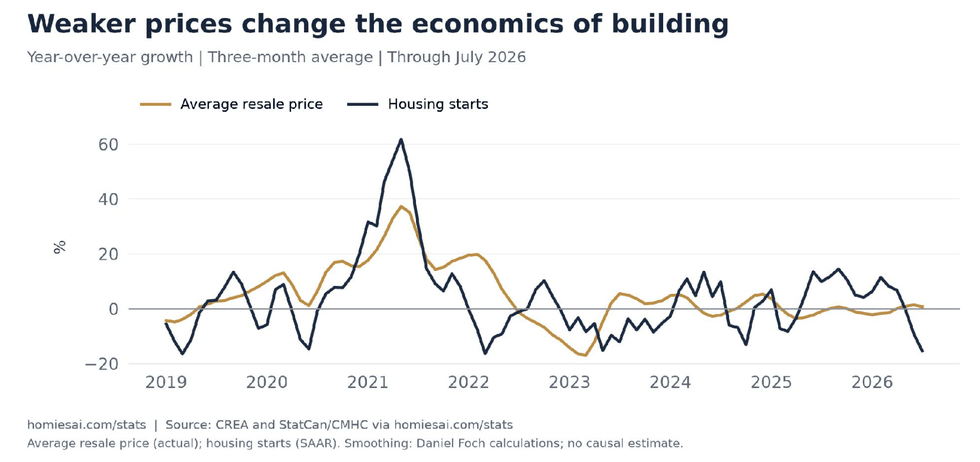 National average resale-price growth and housing-starts growth, smoothed over three months. The comparison illustrates the cycle; it does not establish how much a price change causes construction to change.
This is already visible in the construction data. July housing starts ran at a seasonally adjusted annual rate of 229,074, down 5% from June. Actual starts in centres of at least 10,000 people were down 19% from July 2025. July is the latest available month for these charts; the August construction release follows the August resale report.
A construction start is the beginning of work, not a finished home. Projects already under way can continue adding completed units even as fewer replacements enter the pipeline. Resale inventory can therefore increase today while future additions to the housing stock weaken.
The kind of housing being built matters
A national starts total can obscure a retreat from homes intended for purchase. Purpose-built rental and ownership housing serve different markets, face different financing arrangements and respond to different revenue expectations.
The longer history shows rental construction gaining ground while homeowner and condominium starts have been much less responsive. Grouping them together can make the construction response look stronger for prospective owners than it is.
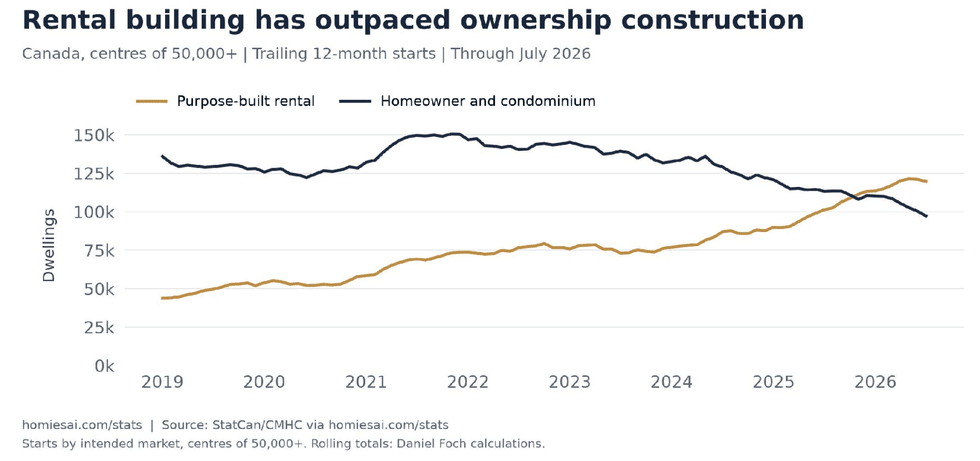 Trailing 12-month starts in centres of 50,000 or more remove the usual monthly seasonality. Ownership combines the homeowner and condominium categories; rental is shown separately.
CMHC reports that ownership construction is particularly weak in Montreal and Ottawa, even as rental development supplies new homes. Vancouver’s condominium starts have fallen to their lowest level in more than a decade. Calgary and Edmonton are exceptions: ownership construction is responding more strongly to demand.
That difference should shape the national discussion. Adding rental apartments can improve renters’ choices and restrain rent increases. It does not automatically produce the same supply of homes available to buy.
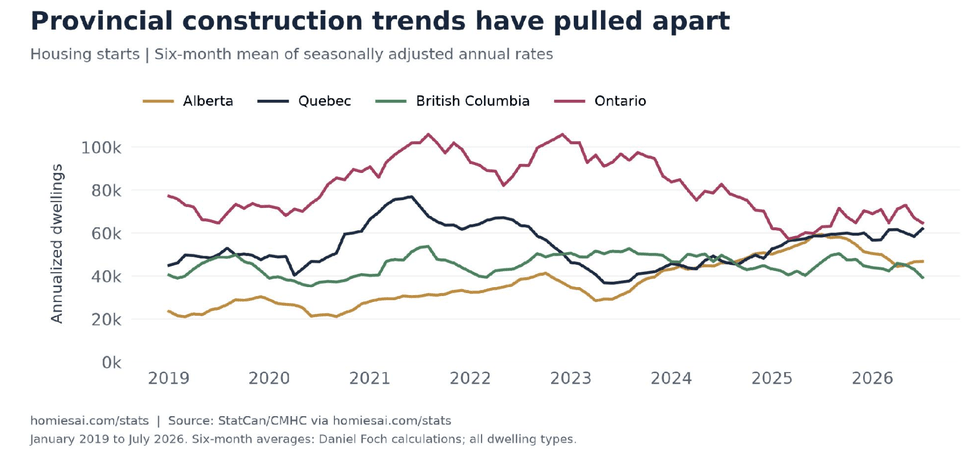 Six-month averages of provincial starts, expressed at annual rates. The smoothing reduces the influence of individual apartment projects.
The economics vary from site to site. Resale prices affect what purchasers are willing to pay for a new home, but land costs, construction costs and financing determine whether a developer can meet that price. A shortage of housing does not, by itself, close the gap between a project’s cost and its achievable revenue.
Affordable markets are losing some momentum too
Ontario and parts of British Columbia continue to bear the largest price losses, but weakness is spreading beyond that familiar account.
Greater Moncton’s benchmark was still 4.8% above August 2025 while sitting 2.9% below its level three months earlier. New Brunswick was up 6.2% annually but down 1.2% over three months. Winnipeg’s annual gain was 2.6%, with prices edging down over the more recent period. Prince Edward Island had declines over both periods.
Quebec City presents a subtler slowdown: its annual gain was 4.5%, but the three-month increase was just 0.3%, and August alone fell 0.7%. A market can retain most of an earlier price increase while running out of momentum.
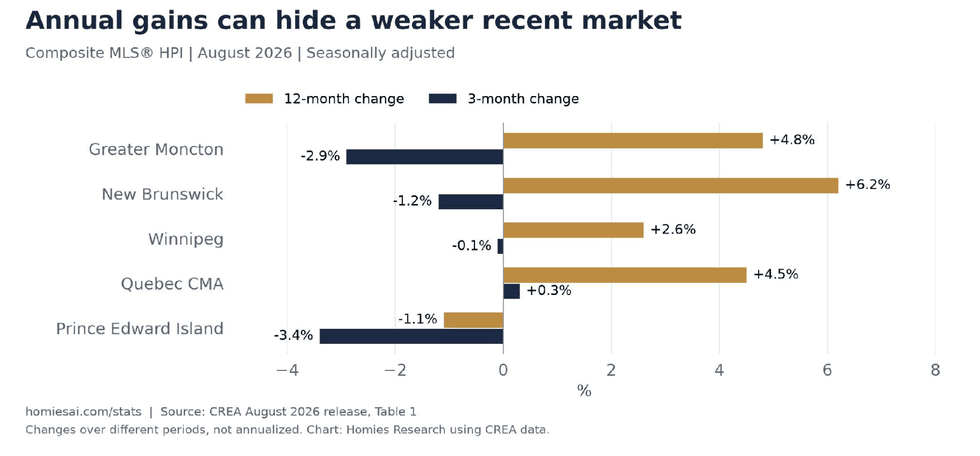 The same August benchmark compared with two different starting points. Three-month changes are not annualized.
These comparisons explain why a positive year-over-year number needs a second look. It can reflect gains made months ago or an unusually weak comparison period. Neither establishes that prices are rising now.
Nationally, the average sale price rose 0.6% annually to $668,219 while the benchmark fell 3%. Changes in the mix of sales can lift an average even when comparable properties have lost value. With the benchmark largely flat since spring, smaller annual declines can also emerge as last year’s weaker months become the comparison base.
There are still markets with current price growth. Regina’s benchmark increased 0.5% in August, and Saskatoon’s rose 0.2%. Both remained higher over three months. Those gains should be recognized, without treating them as evidence that all affordable markets are immune.
The gap in purchase prices remains large. August’s average sale price was roughly $926,000 in British Columbia, compared with $369,000 in Saskatchewan and $349,000 in New Brunswick. These are province-wide transaction averages, with different housing mixes, rather than prices for identical homes.
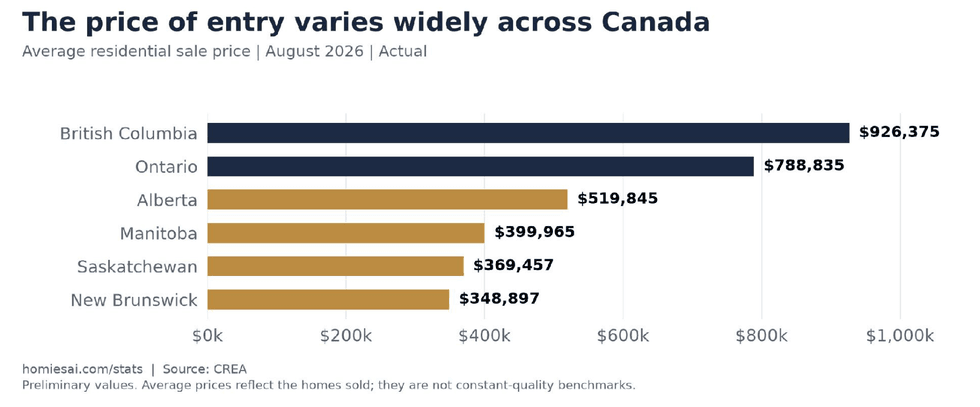 Average sale prices show the difference in purchase costs across markets. They do not measure affordability relative to local incomes or construction costs.
Lower prices have not prevented sales from slowing. All ten provinces recorded fewer sales than a year earlier. Newfoundland and Labrador’s residential sales fell 7.1% in August, despite a provincial benchmark still up 6.8%. Saskatchewan’s sales fell 2.4%. Alberta’s fell 11.5%.
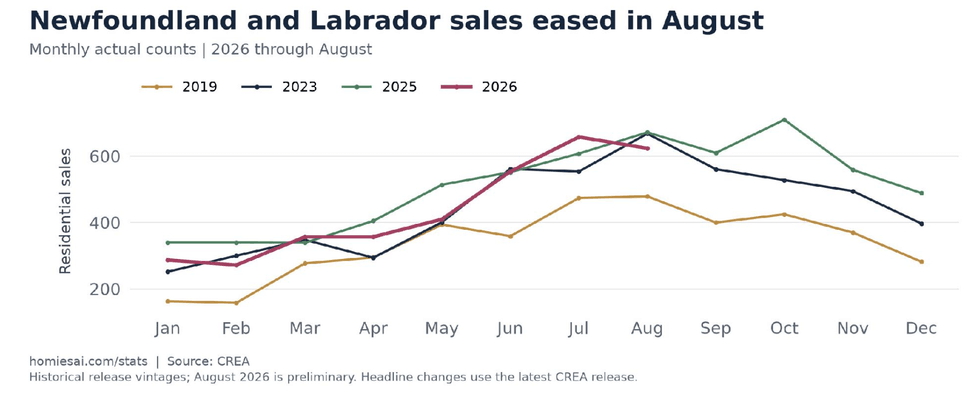 Newfoundland and Labrador remains above its pre-pandemic sales pattern, but August activity was below last year. Historical lines retain their original release vintages.
An oil shock can make cheaper housing harder to finance
The fall market faces a combination of risks that a lower asking price cannot fully offset. Oil costs can raise household expenses and construction costs. Higher bond yields can lift fixed mortgage rates and development financing costs. Trade-war uncertainty can make purchasers less willing to commit while they wait for clarity about employment.
The Bank of Canada’s latest statement warns that persistent high energy prices increase inflation risks, while new tariffs make the growth outlook less certain. An oil-price increase can support incomes in energy-producing regions, so its effects will vary across Canada. A quick return to cheaper borrowing is nevertheless a poor assumption on which to base a purchase or a development budget.
For now, CREA counts just under 200,000 properties for sale, up 1.4% annually. Sales are falling from an already subdued 2025, when national transactions declined 1.9%. That supports buyers’ negotiating position this fall.
Preserving those gains over time requires new homes that can be built at prices households can afford. If the only way a project works is for resale prices to climb again, the affordability improvement contains the reason construction might stall. Canada needs the cost of delivering housing to adjust alongside the price buyers can pay.