It may not be shocking to hear that cities with high rents and low vacancy rates are also seeing an increase in homelessness, but correlation is not causation. But now, a recent study is pointing to causation.
The research was conducted by the Canadian Alliance to End Homelessness (CAEH), who said it was the first study of its kind in Canada, and that their research “demonstrates a clear link between housing affordability, vacancy rates, and increasing homelessness.”
“The report’s findings show that homelessness increased most in communities where the lowest-cost rental housing became more expensive and less available and rental market conditions for those lowest-cost units are getting worse across the country, meaning homelessness is expected to worsen,” said the CAEH.
The Alliance investigated the relationship between homelessness rates and rental market conditions in 36 communities in Canada, and found that communities that saw the largest increase in rent prices and decreasing vacancy rates for the lowest-end rental units also tended to have seen the largest increase in homelessness.
The prime example from the report is Hamilton, Ontario. According to the CAEH, Hamilton saw the vacancy rates of their lowest-cost rental units drop from 2.3% in 2018 to 1.2% in 2024, while the rents increased by around 47% up to $1,200 per month. (The median single-person income for Hamilton only grew about 18.9% in that span.) During that period, homelessness in Hamilton increased by 224%.
“We found a clear relationship between homelessness rates and rent prices for lowest-quartile units, as communities with the greatest increase in rent price tended to have the largest increase in homelessness,” said the CAEH in a report. “In other words, the more rent increased for the lowest-cost rental units, the higher the rates of homelessness.”
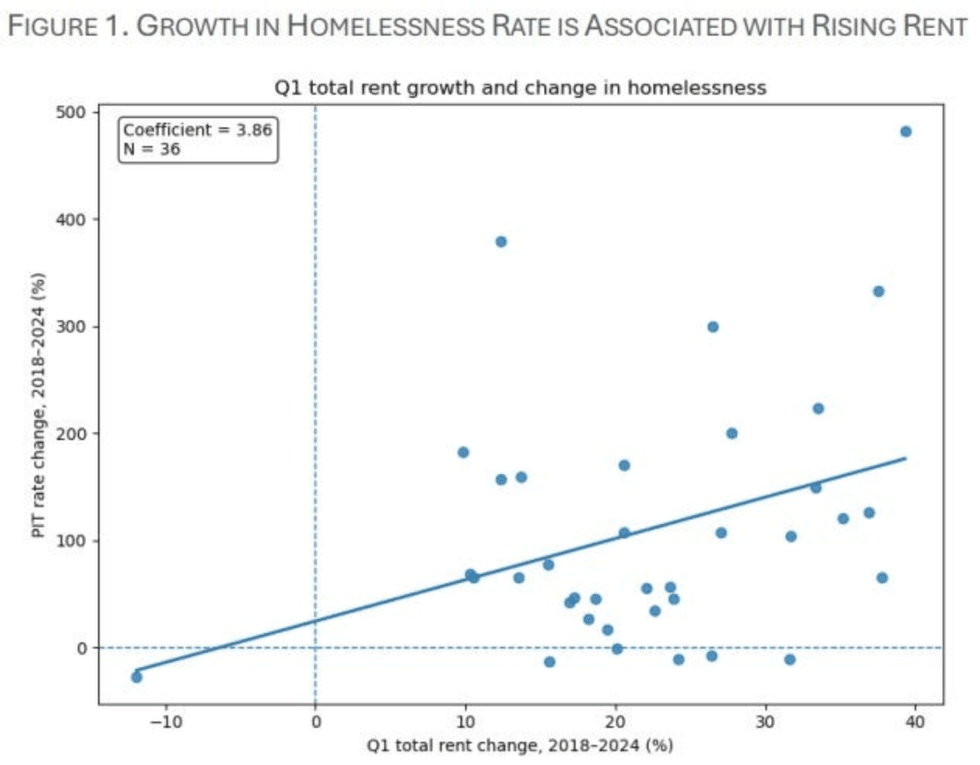
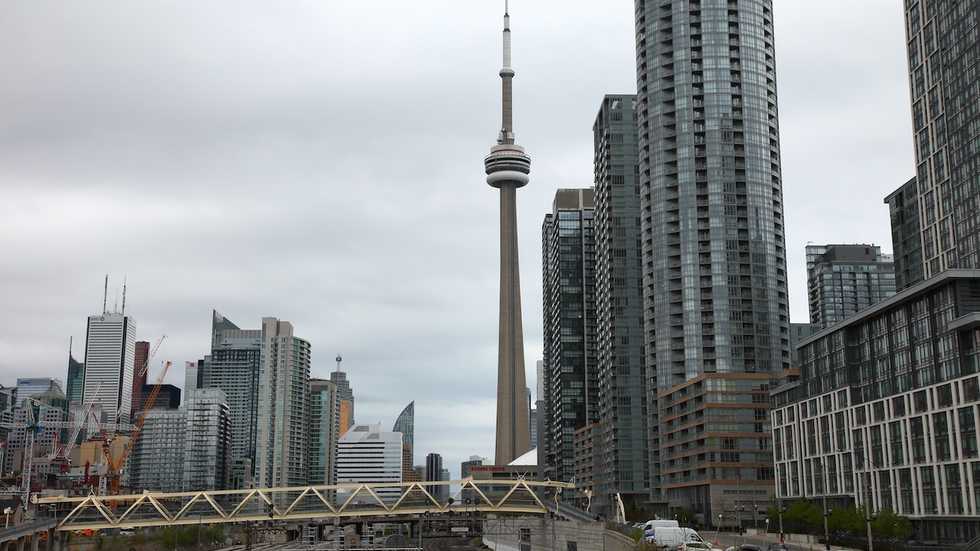
“That relationship holds for recent asking rent prices as well, as our analysis found a statistically significant correlation between higher homelessness rates and higher rental prices,” the CAEH added. “We compared rates of absolute homelessness in the 15 most populous Canadian CMAs with the average asking rents for private market units in the last quarter of 2024. Again, we found that communities with the highest average rent prices in 2024 — places like Toronto, Kelowna and Kitchener-Waterloo — often had the highest rates of homelessness.”
On the other end of the spectrum, communities with lower average asking rents, such as Edmonton and Winnipeg, typically also had lower rates of homelessness.
Similarly, the study found that as vacancy rates decreased, homelessness tended to increase, with communities that saw the biggest decrease in low-cost rental units seeing the largest increases in homelessness and communities that saw vacancy rates increase seeing the smallest increase in homelessness.
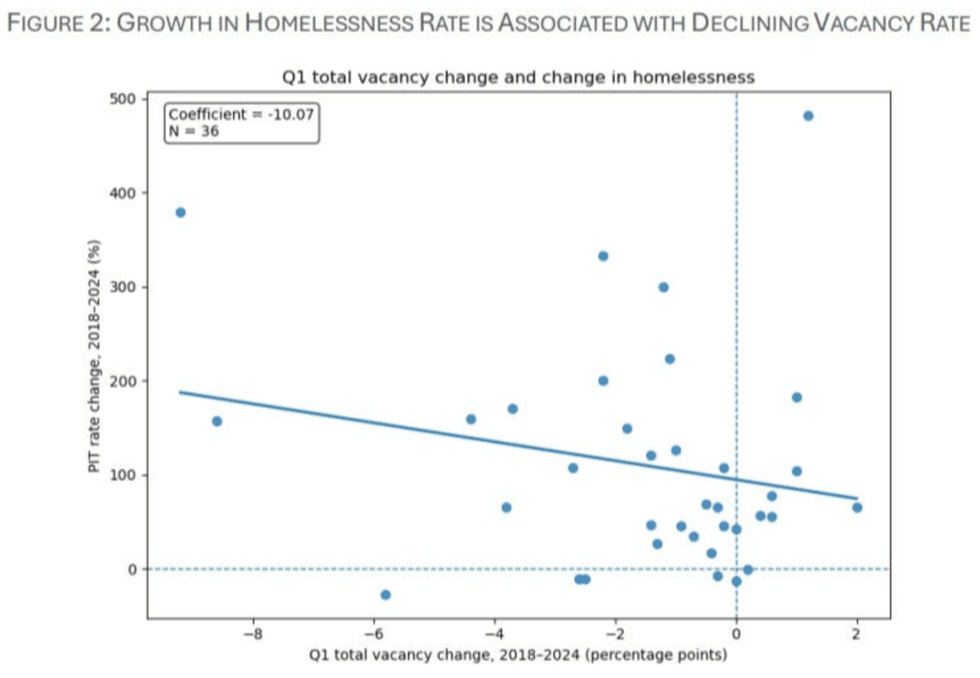
“Overall, our preliminary findings demonstrate a clear relationship between changing rates of homelessness and market conditions for the lowest-cost rentals,” said the CAEH. “When the most affordable rental units in a community become more expensive and less available, homelessness tends to increase. […] That is a significant cause for concern, because our analysis has found that the lowest-cost rental market has become less affordable and less available over the past decade.”
The CAEH also found that, although average rents across Canada are decreasing, it’s a different story for the segment of the rental market with the lowest cost, which are still becoming increasingly unaffordable — even in markets like Halifax and Moncton, not just Vancouver and Toronto.
The researchers used an affordability ratio metric to quantify this and found that of the 36 communities, 27 saw the affordability ratio increase and 24 communities saw the average low-cost rental price become more than double what would be reasonably affordable when factoring in income.
“While rental housing supply has expanded in recent years, the benefits have largely failed to reach the Canadians most at risk of experiencing homelessness, because new supply is being added at the higher end of the market price,” the report concludes.
“Newly constructed rental units have not eased the pressure for the lowest end of the rental market. Instead, prices have risen, and vacancy rates have dropped for the lowest-cost part of the rental market. Many Canadians cannot afford to rent even the cheapest units in their community, and the affordability gap is growing, locking more Canadians out of the market and pushing more people into homelessness.”