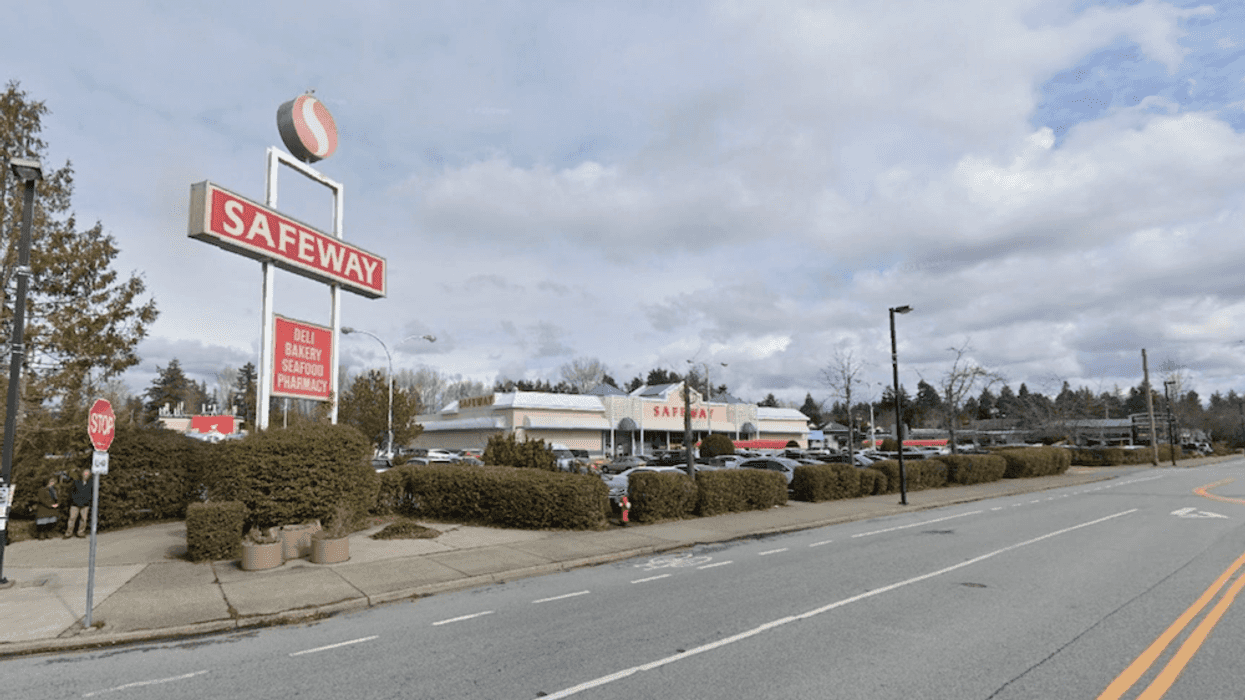
Nova Scotia-based Crombie REIT (TSX: CRR.UN) has completed an acquisition of a Safeway in Surrey, British Columbia, according to their Q2 2026 financial report published last week.
The Safeway is located at 12825 16 Avenue, at the northeast corner of the intersection of 16 Avenue and 128 Street in South Surrey.
The Safeway appears to be part of the Ocean Park Shopping Centre as it shares a parking lot, but is actually a separate legal parcel. The Ocean Park Shopping Centre — home to Rexall, BC Liquor, Coast Capital Savings, Cobs Bread, and others — is owned by Rural Stores Ltd. under Rural Stores Limited.
Safeway Ocean Park is now owned by Crombie REIT under Crombie Property Holdings Limited. According to their Q2 report, the REIT acquired the property in late April from a subsidiary of Empire — the conglomerate that owns Safeway and is one of the largest unitholders in the REIT.
Crombie REIT says they acquired a 100% ownership interest in the property for $12,700,000, excluding closing and transaction costs, then leased the property to a subsidiary of Empire, presumably referring to Safeway.
The property totals 30,000 sq. ft and has been classified under the REIT’s “income-producing” strategy, as opposed to under the “redevelopment” strategy, so redevelopment is not currently the plan, although things may change in the future.
Crombie REIT’s Projects In BC
Crombie REIT’s Q2 2026 report also outlined a list of 25 sites under its “major development pipeline,” and 12 are located in British Columbia.
The list includes two projects classified as “near-term” projects.
The first is the Belmont Market project at 3011 Merchant Way in Langford, on Vancouver Island. Phase One was completed in 2020 is consists of an open air shopping centre anchored by a Thrifty Foods — another chain owned by Empire. Phase Two is set to include approximately 200 residential units, and Crombie has secured entitlements for the project.
The second is the redevelopment of the Safeway next to Commercial-Broadway Station in Vancouver that Crombie is undertaking with Westbank. After multiple rounds of revisions and an extensive public hearing that saw strong opposition to the project, Vancouver City Council approved the three-tower project last year. Crombie said in its Q2 report that rezoning by-law enactment is expected before the end of the year. It has also suggested that it may explore “monetization” of the project, in which it owns 100% of the retail component and 50% of the residential component.
Crombie has then classified two projects in BC as “medium-term.”
The first is the redevelopment of the Safeway at 1170 E 27th Avenue in North Vancouver, located to the west of the Lynn Valley Centre shopping mall. Crombie previously submitted a preliminary application in November 2021 for four residential buildings with a total of 479 residential units, then announced Wesgroup Properties as a 50/50 joint venture partner last year. Crombie said in its Q2 report that they are evaluating the project design, and have yet to submit a formal rezoning application.
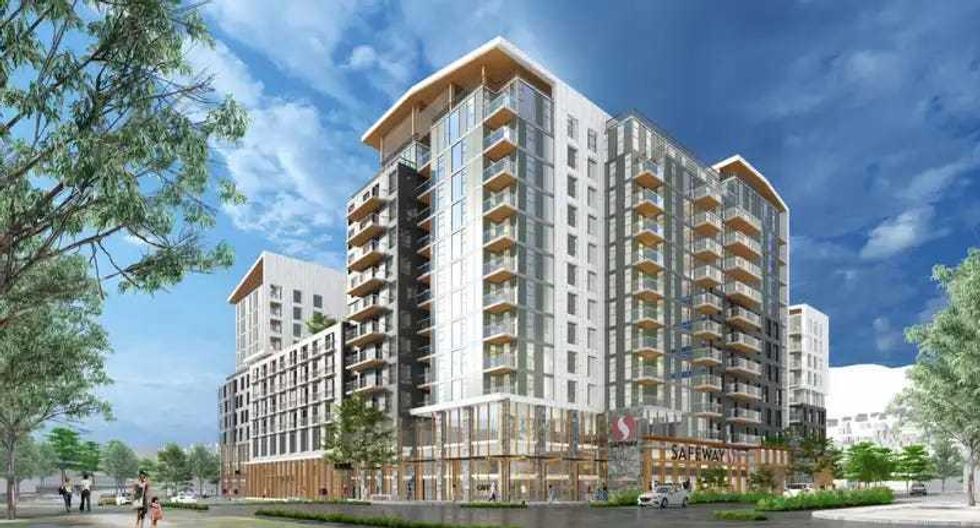 The preliminary proposal for the Lynn Valley Safeway at 1170 E 27th Street in North Vancouver. (Crombie REIT)
The second “medium-term” project is the Safeway at 8860 152 Street in Surrey, which Crombie acquired in 2013 as part of its acquisition of 70 Safeways. The redevelopment plans for the site are currently unknown, and Crombie said it has yet to secure development entitlements for the site.
Last but not least are the eight properties in BC classified as “long-term” projects.
Those include the three other Safeway redevelopments owned by Crombie REIT’s joint venture with Wesgroup — 3400 Kingsway in Vancouver, 2733 West Broadway in Vancouver, and 4440 Hastings Street in Burnaby. In all three cases, Crombie said in its Q2 report that “The joint venture is currently working through early concept planning and due diligence to support a rezoning application.”
The remaining long-term projects include the Safeways located in Port Coquitlam and New Westminster, as well as the Safeways on King Edward Street in Vancouver, Robson Street in Vancouver, and Bernard Avenue in Kelowna.
The REIT states in the report that all of the properties “are transit-oriented and have the potential for residential expansion.”