Canada's multifamily market caught its breath in the second quarter of 2026.
After nearly two years of climbing vacancies and cooling rents, the latest data from Yardi shows a sector settling into something closer to equilibrium — moderate growth, mixed performance by market, and the first real sign that the supply wave weighing on landlords might be cresting.
The numbers tell a story of deceleration more than decline. The national average in-place rent rose just $6 in Q2 to $1,774, the smallest quarterly increase since Q2 2021. Year-over-year growth came in at 2.2%, less than half the pace recorded a year earlier, and the lowest reading since Q4 2021. Most of that growth is coming from renewal leases, since new lease rates have slipped into negative territory.
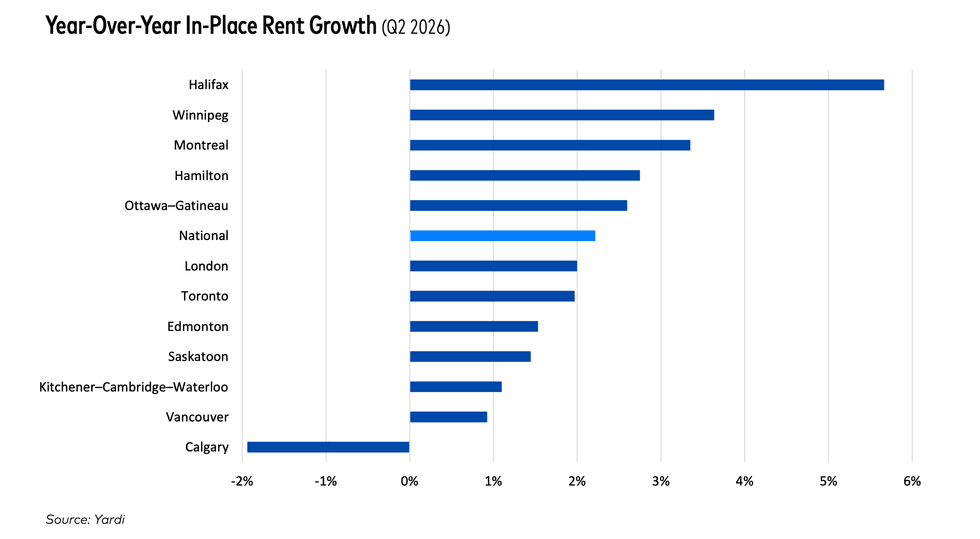
Halifax remains the market to watch. In-place rents there climbed 5.7% ($93) year-over-year, well ahead of the pack. Winnipeg (3.6%, $56), Montreal (3.4%, $59), Hamilton (2.7%, $41) and Ottawa-Gatineau (2.6%, $44) also posted solid gains.
Calgary was the outlier in the other direction, as the only CMA where in-place rents actually fell compared to a year ago, down 1.9%, or $36.
 Yardi
Yardi
New lease pricing tells a rougher story. Lease-over-lease rates — what landlords can charge when a unit turns over — were negative nationally for the second straight quarter, down 0.6%, though that's an improvement from the 1.0% decline in Q1. The weakness is concentrated in Ontario, British Columbia and Alberta, where oversupply and affordability pressure have collided. Kitchener-Cambridge-Waterloo posted the steepest drop at 4.5%, followed by Toronto (2.8%), Calgary (2.2%) and Vancouver (2.0%).
Halifax, meanwhile, is going the other way, with new lease rates up 2.5%. Ottawa-Gatineau (1.5%) and Hamilton and Winnipeg (both 1.3%) also improved — and Hamilton and Winnipeg were the only two CMAs where growth actually accelerated compared to the same quarter last year.
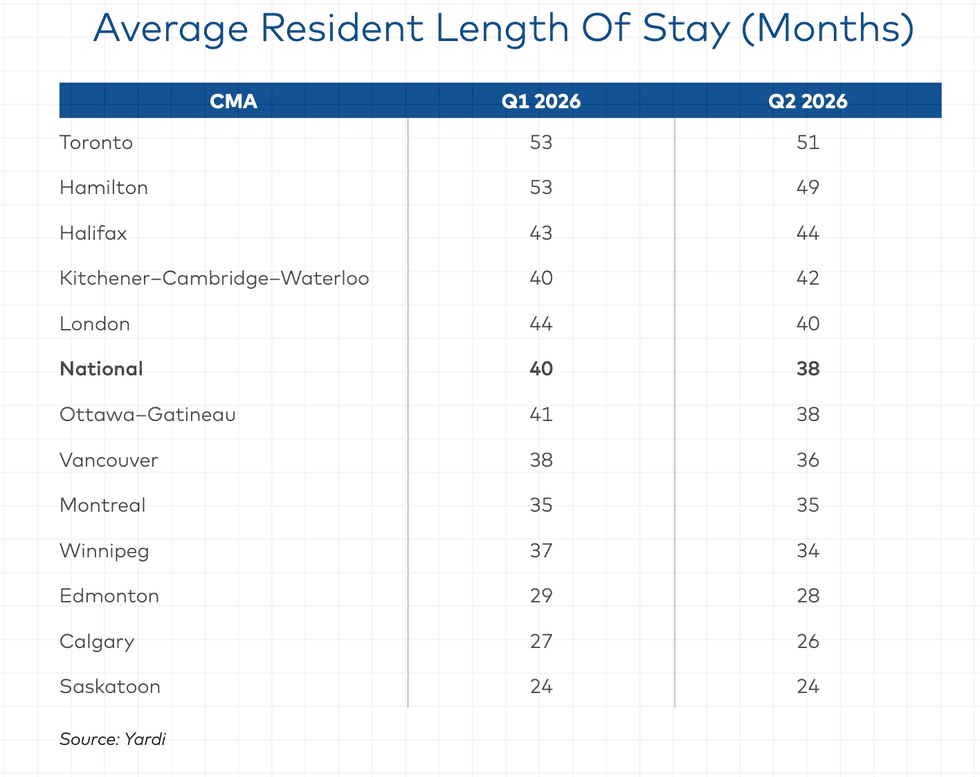
Vacancy is where the quarter's real headline sits: the national rate fell 40 basis points to 4.7%, snapping a streak of nine consecutive quarterly increases and marking the first decline since Q4 2023. It's still elevated compared to a year ago — 60 basis points above the 4.1% recorded in Q2 2025 — but the direction matters. Halifax (2.4%) and Winnipeg (2.8%) posted the tightest markets in the country, while Calgary (6.8%) and Edmonton (5.8%) remained the loosest, even as both improved from the first quarter. Turnover crept higher too, hitting 26.2% nationally, up from 24.2% a year earlier, while the average tenant stuck around for 38 months, up slightly from 37.
 Yardi
Yardi
Supply helps explain why vacancy climbed as long as it did — and why relief may be on the way. Purpose-built rentals accounted for more than half of all Canadian housing starts in 2025 for the first time on record, according to a BMO Capital Markets analysis of Statistics Canada data, with 113,200 apartment starts making up 50.6% of the total. That trend has only strengthened in 2026: apartments represented 59.1% of the 85,500 housing units started through May. It's a dramatic shift from a market where purpose-built rentals didn't crack even a third of all housing starts until 2021. Deliveries followed suit, topping 100,000 units for the first time in 2025, and accounting for 45% of all completions that year. Through May 2026, purpose-built rentals made up nearly half — 49.9% — of all housing deliveries nationally.
That said, the pipeline may be starting to narrow. Residential building permits have pulled back in some markets, with Halifax down 9.7% in the first five months of 2026 compared to the same period last year — a signal that today's construction boom won't necessarily carry through indefinitely.
All of this is playing out against a choppy economic backdrop. GDP contracted in both Q4 2025 and Q1 2026 before rebounding with 0.5% growth in April, according to government figures — inconsistency that points to a slow, uneven transition rather than a clean recovery. Inflation edged up 40 basis points to 3.2% in May, driven by energy, food and housing costs, even as consumers largely held their ground. The labour market has been similarly erratic: Canada shed 112,000 jobs over the first four months of the year, then clawed back nearly all of it in May and June, per Statistics Canada. Construction and transportation and warehousing have been adding jobs, while manufacturing has lost more than 60,000 since January 2025 as tariffs continue to bite. The national unemployment rate has eased to 6.5% in June from a peak of 7.1% last September, and youth unemployment — a key driver of new household formation — dropped nearly two full points since the fall, to 12.7%.
Policy is starting to lean into the supply conversation as well. The federal government and British Columbia have each committed up to $1.6 billion over 10 years to spur multi-unit housing development, lowering development charges and expanding infrastructure like water, wastewater and local roads. Ottawa also plans to purchase up to 2,200 vacant condo units and convert them into affordable housing. The details — particularly around provincial development tax and fee rebates — are still being worked out, which makes the near-term impact hard to pin down. But the direction of travel, like the market itself this quarter, is at least aimed toward stability.