Last week, Surrey City Council approved an update to its bylaw governing development cost charges (DCCs), reducing rates at a time when homebuilders are struggling to advance new construction.
In 2025, the City of Surrey began the process of updating its 2024 DCC Bylaw in response to new provincial legislation. The updated bylaw was submitted to the Province for review, but City staff say the review was delayed due to “job action” at the Province, so the 2024 bylaw remains the most current.
The City is now moving past what would have been the 2025 DCC Bylaw to the 2026 DCC Bylaw, which will see DCC rates reduced across the board for residential construction, by between 7% to 9%.
The DCC rate for small-scale multi-unit housing (SSMUH) lots — multiplexes — was $55,260 per unit in 2024, and is being reduced to $51,633. The rate for low-rise residential buildings is being reduced from $33.47 per sq. ft to $30.72 per sq. ft., while the rate for high-rises is being reduced from $33.18 per sq. ft to $30.30 per sq. ft.
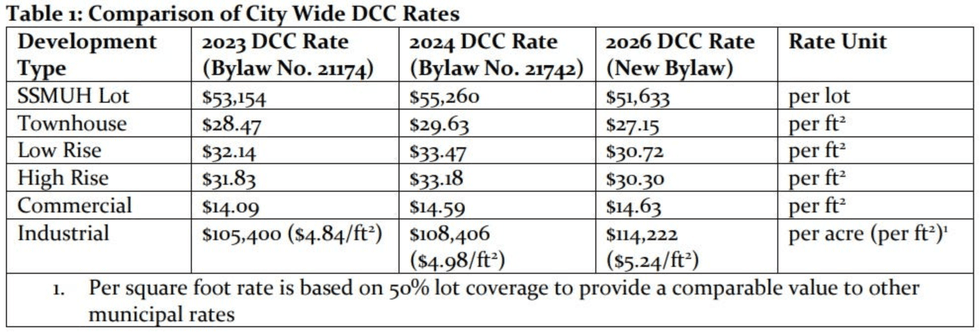
DCC rates for commercial and industrial buildings, however, are being increased. According to a staff report, the DCC reductions are possible for residential development “due to a decrease in program value for Parks Acquisition and Improvements and Collector Roads, and an increase in DCC reserves,” but were not possible for commercial and industrial because they do not pay Park DCCs and the existing DCC rates are already significantly lower than those for residential.
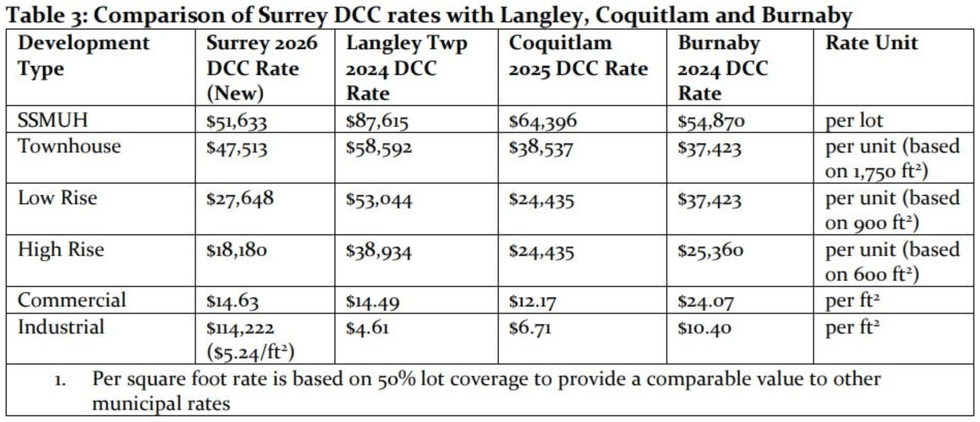
The updated residential DCC rates, the City says, compare favourably to other municipalities.
“In comparison to Township of Langley, City of Coquitlam, and City of Burnaby, Surrey’s proposed 2026 DCC rates are similar or lower that these municipalities with growth demands and a mix of new and redevelopment,” said staff. “Surrey’s rates are lowest in terms of high-rise developments, where Surrey provides a large number of units per year, leading to lower DCC rate per unit.”
“Higher DCC rates are seen for townhomes; however, due to Surrey’s per square foot charge, the actual cost per unit is variable and would be lower than the comparables for a smaller 1,200 sq. ft. unit (a total of $32,580).”
“If we want people to be able to live and buy a home in Surrey, we need to make housing more affordable to build,” said Mayor Brenda Locke in a press release. “By lowering DCCs, we are supporting the delivery of more homes for current and future residents while continuing to invest in the roads, utilities, parks, and community amenities a growing city needs.”
The 2026 DCC Bylaw has now been submitted to the Province for approval, after which it will return to Council for final adoption. The new rates would come into effect immediately upon final adoption.
Amenity Cost Charges (ACCs)
At the same council meeting last week, however, Surrey City Council also endorsed a new amenity cost charges program, which are similar to DCCs and were created by the Province in Fall 2023 as a way to replace community amenity contributions (CACs).
“In accordance with the [Local Government Act], ACCs fund only the population and employment growth-related portion of capital costs,” staff explained in a report. “The non-growth-related portions of amenity capital costs will be funded through other sources, such as, general revenues, reserves, borrowing, and external funding sources where available. ACC rates are structured to recover eligible growth-related costs (including allowable financing), while balancing impacts on development.”
The City has proposed two funding streams for the ACC program. The first stream will generate $350 million to fund the capital costs of city-wide amenities including a community centre, interactive art museum, park features, and more; while the second stream will generate $147 million to fund a portion of capital costs and interest associated with replacing the Newton Recreation Centre.
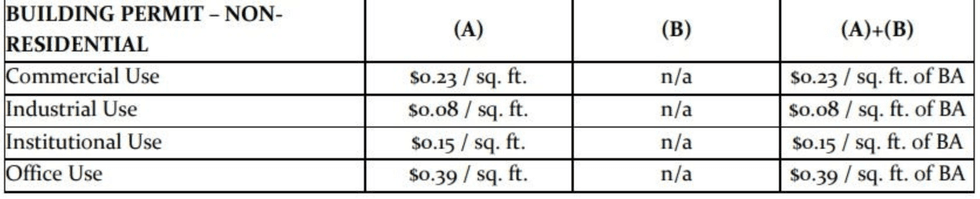
The total ACC rate is $10.58 per sq. ft of building area for apartments and $6.87 per sq. ft for townhouses. For non-residential buildings, the rates are all below $0.39 per sq. ft. According to the City, many of the proposed rates are reductions from the rates the City previously outlined during public consultation.
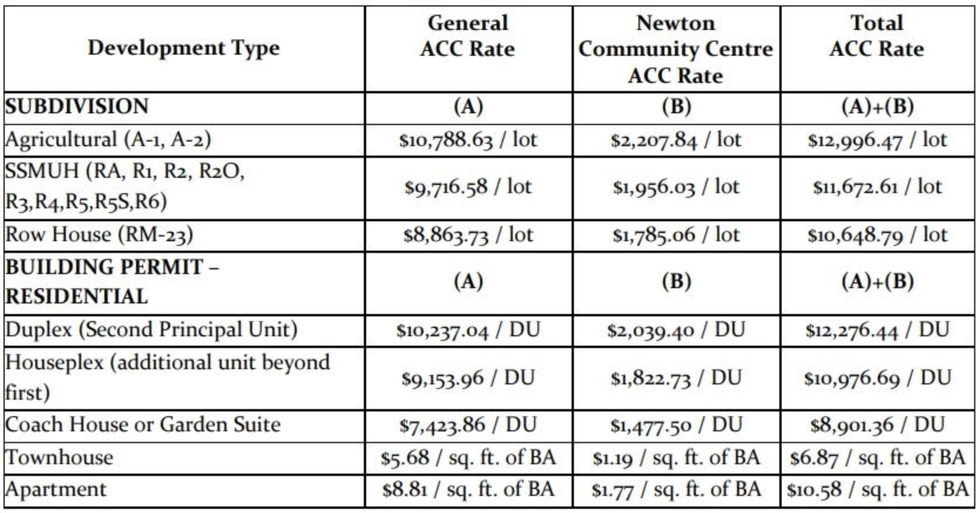
The City says it retained Coriolis Consulting Corp. as a consultant to evaluate the financial impacts of the new ACC program and that Coriolis concluded that apartment projects will generally see lower fees under the new ACC program than under the previous CAC program.
Not-for-profit rental housing operated by a public housing body will be eligible for a full ACC waiver. For-profit affordable rental housing, with rents at least 10% below CMHC medians for the City of Surrey, will be eligible for a full or partial ACC waiver depending on the length of the housing agreement securing the affordability. If the housing agreement is for over 60 years, the project will be eligible for a full waiver, while agreements for less than 60 years will be eligible for partial waivers, depending on the length.
Similar to DCCs, payment of ACCs can also be partially deferred, with 25% payable upon subdivision approval or building permit issuance and the remaining 75% upon receiving occupancy or after four years.
Last week, Surrey City Council endorsed the new ACC program. City staff is now working on preparing the requisite bylaws, which will be presented to Council for readings at a later date.