It’s no secret that developers have lost faith in Canada’s once-booming condo sector. It’s also no secret that the rental segment has emerged as something of a saving grace for the housing market, with new and pivoted projects alike benefiting from government-backed incentives. But a new report from Desjardins underscores that the broad volley from condo to rental is not a risk-free trade-off.
Authored by Economist Kari Norman, the report points out while there have been around 130,000 rental housing starts recorded over the last four quarters, condo starts have slipped below the 50,000-mark for the first time since the 2009 global recession.
“This pivot reflects a dramatic change in market conditions,” writes Norman. “Condo projects depend heavily on investor presales to secure construction financing, but those presales have fallen sharply as investors retreat from the market. Higher interest rates have eroded affordability and made financing more expensive for both buyers and developers.”
“By contrast, targeted Canada Mortgage and Housing Corporation financing programs and the removal of the GST on new rental construction have significantly improved the economics of purpose-built rental projects,” Norman goes on to say.
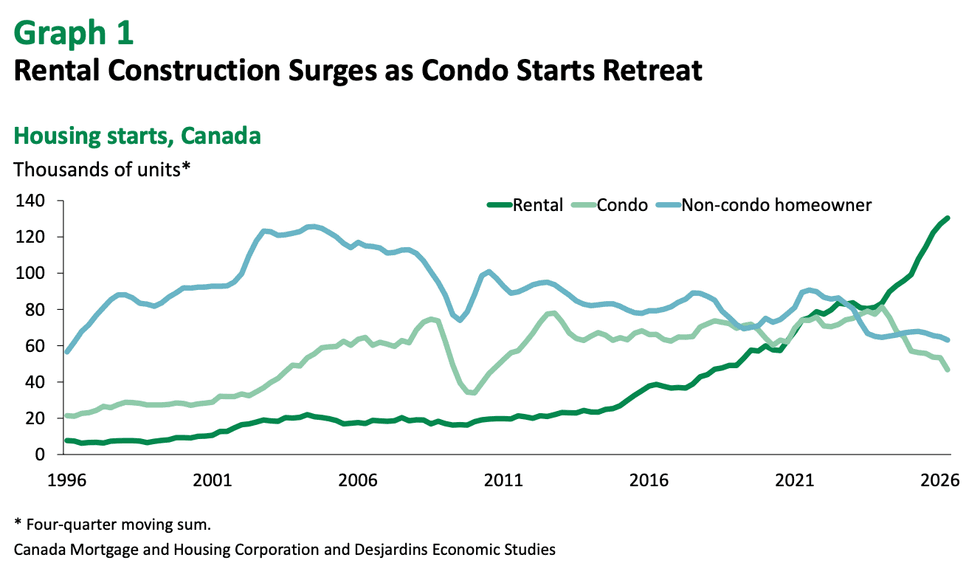
The uptick in rental construction is inherently a good thing. Canada has been under-building purpose-built rental housing since the 1990s, and the country has grappled with a deep deficit for decades. But the shift to rental is also masking a steep decline in the pipeline of homes meant for ownership, says Norman, particularly as it becomes more common for condo developments to be pivoted to rental.
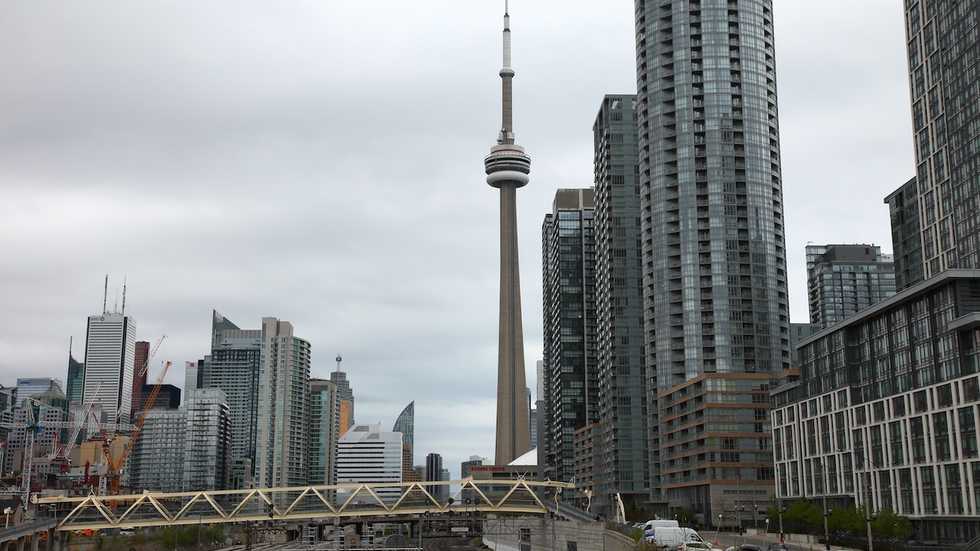
In the Greater Toronto Hamilton Area (GTHA), for instance, 11,424 condo units were cancelled between 2024 and the first quarter of 2026, according to research from Urbanation, and of those, 4,064 were converted into purpose-built rental.
“Until recently, it was pretty rare to see new condo projects cancel and convert to rental,” Urbanation President Shaun Hildebrand told STOREYS in a September 2025 interview. At that time, 1,778 individual units across nine condo projects had been converted to rental since the beginning of 2024. “Before 2024, only seven did so during the previous 10 years. Today, almost every condo project struggling to sell is looking at the option to convert to rental.”
We’re seeing this happen in real time. In one recent example, Minto Communities filed a major revision to its Grand Park Village project — a five-building, mixed-use community coming up down the street from the Mimico GO station — shifting the proposed unit tenure from condo to rental. Although there isn’t data like Urbanation’s on condo-to-rental pivots for other Canadian markets, this is not a GTHA-specific occurrence.
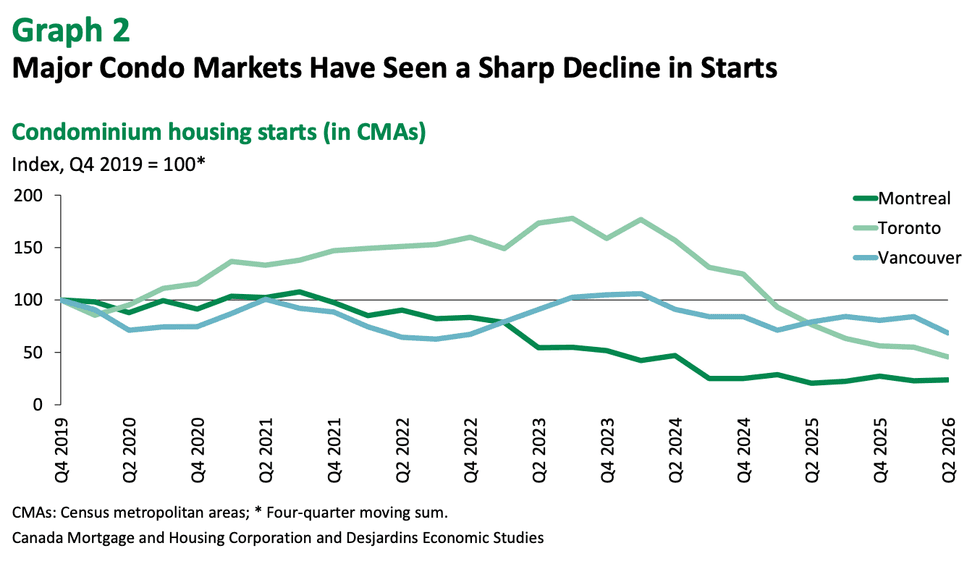
“The longer-term implications need to be considered,” says Norman in her report. “Many aspiring homeowners see condos as the first rung on the property ladder, particularly in major cities where the high price tag of detached housing is beyond their reach. With investor presales weakening, condo starts in Montreal, Toronto, and Vancouver are all now well below their 2019 levels.”
“With large condo developments taking several years to move from presales to completion, today’s sharp decline in starts may not become fully visible in completed supply until later this decade,” Norman adds. “Currently, there isn’t a shortage of homes for sale. But there’s a risk that demand — whether from investors or prospective owner-occupiers — could grow faster than new projects can be approved, financed, and built. Even a gradual recovery in demand could coincide with relatively few new ownership units coming to market, renewing upward pressure on prices.”
The Desjardins report says that Canada is already facing a 30,000-unit slump in housing starts intended for ownership. Starts data indicates that the ownership share of starts has sunk from 70% to about 45% in the four quarters leading up to Q2 2026.