National home sales edged up 0.5% month-over-month in July, according to the Canadian Real Estate Association's latest data — the fourth consecutive monthly gain and, per CREA, a near-replica of what happened in June.
Listings fell and prices held steady as the market continued its drift towards balance.
Actual (not seasonally adjusted) activity in July still landed 5.3% below where it stood a year earlier. New listings slipped 1.6% month-over-month, the third straight monthly decline, tightening the national sales-to-new listings ratio to 51.3% — close to the long-term average of 54.7%, and comfortably inside the 45%-65% range CREA considers balanced.
"At the national level, July's housing data was a carbon copy of the June numbers, with home sales edging up a little further, listings down, and prices remaining stable," said Shaun Cathcart, CREA's senior economist. He pointed to the real story sitting underneath those topline figures: markets across the Prairies, Quebec, and the East Coast have been steadily cooling out of seller's-market territory over the past year, and more recently, the same shift has shown up in B.C.'s Lower Mainland and Ontario's Greater Golden Horseshoe — both of which have moved from buyers' or borderline-buyers' conditions back into balance.
There were 205,388 properties listed for sale across Canadian MLS Systems at the end of July, up just 0.6% from a year earlier and 1.5% above the long-term seasonal average. Inventory has been holding close to that average for over a year now. Months of inventory came in at 4.7 nationally — the lowest reading so far in 2026, and just under the long-term average of 5 months. (For context, CREA defines a seller's market as anything below 3.6 months of inventory, and a buyer's market as anything above 6.4.)
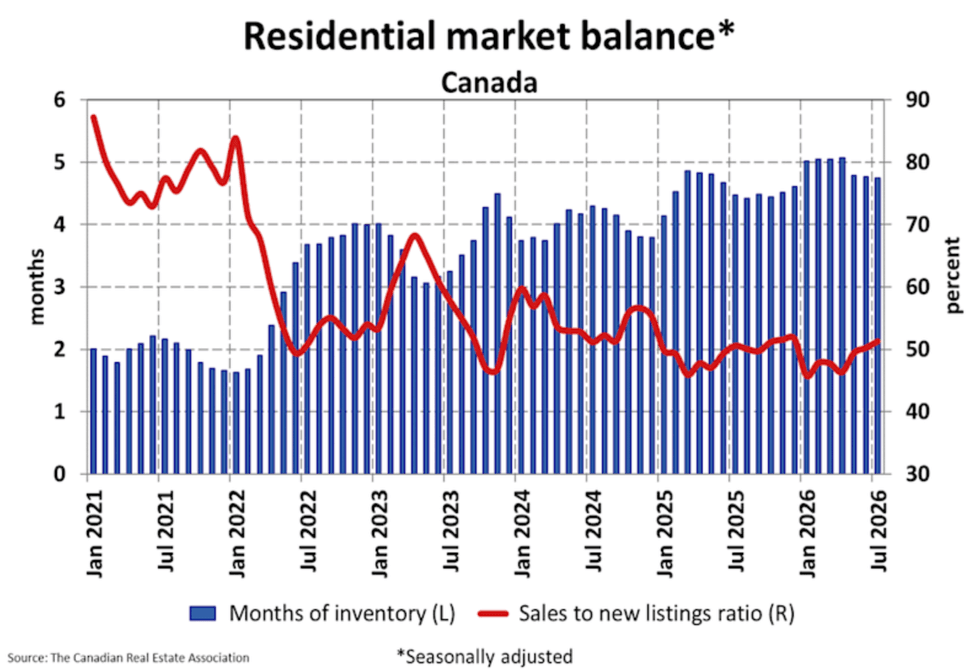
Saskatchewan, New Brunswick, and Newfoundland and Labrador remain the exceptions, still sitting in borderline seller's-market territory. Ontario, meanwhile, has come a long way: after spending the first four months of 2026 in buyer's-market conditions, its months-of-inventory reading in July was only about half a standard deviation above average.
On price, the National Composite MLS Home Price Index ticked up 0.1% from June to July — the first month-over-month increase in the index since November 2024. It's still down 3.3% year-over-year, but that annual decline has been shrinking steadily since January, and July's reading marks the smallest year-over-year drop since October 2025. The non-seasonally adjusted national average home price landed at $674,819 in July, up 0.2% from the same month last year.
"The ongoing shift towards a more normal balance between supply and demand in so many markets across Canada is good news for buyers, whether that means not having to worry about your new home falling in value, or not feeling pressured to make a decision due to competing offers," said Garry Bhaura, CREA's chair, adding that moderating conditions should keep drawing buyers off the sidelines going forward.