It’s no secret that Canada’s homebuilding sector has weathered a few tough years. The country’s new condo sales in places like the Greater Toronto Hamilton Area (GTHA) have hit lows we haven’t seen in decades. The root causes – things like reduced immigration, high construction costs, elevated interest rates, and the collapse of investor demand – have created a perfect storm of volatility. An increasingly uncertain geopolitical climate (to say the least) doesn’t help.
So, it’s become common for Canadian developers to drop like dominoes, putting projects on hold or cancelling them altogether. Some, however, have strategically shifted focus to adjust for the changing times. This could mean moves like a pivot to purpose-built rentals, recapitalizing assets, increased cost consciousness, leveraging government incentives, and a reliance on vertical integration.
The common denominator? These developers aren’t sitting on the sidelines.
From Quick Flips to Forever Yields
Purpose-built rentals continue their moment in the spotlight, as more developers have shifted from a reliance on condo pre-sales, to a focus on a more stable, recurring income in recent years. In 2025, Canada’s purpose-built rental starts hit an all-time high, according to Canada Mortgage and Housing Corporation (CMHC). Notable Canadian developers like Dream Unlimited Corp, Bosa Properties, and even the commercial real estate-focused RioCan have set their sights on the rental market as of late.
“Our pipeline is now split almost evenly between purpose-built rental and condo, and we continue to take a long-term view for both,” says Dan Cupa, SVP Residential at Vancouver’s Bosa Properties. He says the current market structure requires an innovative shift.
“With rental now the dominant form of housing activity, competition is increasing, and that raises the bar,” says Cupa. “Success is measured by resident retention, operational performance, and the durability of the asset over time, which means designing rental communities with renters’ needs squarely in mind and continuing to provide exceptional property service.”
Pre-sales still matter, however. “For us, it isn’t a choice between pre-sales and rental yield,” says Cupa. “A healthy housing system needs both. Programs like BPI Equity [Bosa Properties’ rent-to-own program] reflect that reality by supporting renters who want a pathway into ownership, allowing us to build stronger relationships with our customers across different stages of their housing journey. Ultimately, success means delivering housing that works for how people live today and performs over the long term.”
While pre-sales are still important, the waning of the investor-driven condo market means a mass move away from the “investor shoebox” era that started around 2010. “Success today means designing homes for end-users with a focus on livability and enduring value,” says Cupa.
The Daniels Corporation is no stranger to purpose-built rentals, having built them in Toronto for over 30 years. While many developers may have been caught off guard by the conditions in 2024-2025, Daniels had the experience to shape how they plan capital in a way that supports housing through multiple market cycles, says Jake Cohen, President of the Daniels Corporation.
“While the current environment has reinforced the importance of that approach, our focus has long been on capital structures that prioritize resilience, diversification, and durability over short-term returns,” says Cohen. “Today, that means deepening our emphasis on purpose-built rental, including seniors’, student, affordable, and accessible housing, alongside low-rise development opportunities that respond to real demand and support more predictable outcomes.”
This allows Daniels to remain active while underwriting projects with longer horizons and greater financial durability, says Cohen.
Selling Yesterday to Fund the Future
While some developers may wait for conditions to improve or rates to drop, others are busy pruning their portfolios to finance the future. Some are selling off non-core assets in order to fund rental projects.
With properties across the country, Dream Unlimited Corp. has been an industry benchmark for recapitalization. In the past 18 months, the developer has sold off non-core assets, like Colorado’s Arapahoe Basin Ski Resort, in order to crystallize a $110 million USD profit to repay over $100 million in debt and bolster the liquidity needed to fund its massive recurring-income rental pipeline.
In August, Dream Impact Trust published a general business update on its liquidity, development, and strategic initiatives, revealing that it started the year with almost $350 million in land loans, and that it expects to reduce that total by $140 million. The developers claimed the loans have put a strain on their cash flow and liquidity. By the end of 2026, the Trust expects land loans to be reduced by over 60% compared to 2025 levels, primarily through strategic sales at Scarborough Junction and Quayside.
Similarly, RioCan REIT is in the midst of a massive $1.3–$1.4 billion capital recycling program. By offloading stakes in completed RioCan Living rental towers in Ottawa and Calgary to other REITs, the firm is generating the liquidity needed to deleverage its balance sheet while focusing on its core grocery-anchored residential pipeline.
The Public-Private Playbook
While government red tape has been blamed in part for delays in getting new homes built, strategic public-private partnerships are now fuelling the creation of new homes. “We’re seeing greater alignment from governments around the need to get housing built, particularly rental, even as the economics remain challenging,” says Cupa. “That doesn’t remove risk, but it does reinforce the importance of staying active rather than waiting on the sidelines.”
Government incentives like the removal of tax on new rental construction, CMHC’s Apartment Construction Loan Program, and the Housing Accelerator Fund have helped the homebuilding cause for developers who take advantage of them.
“The removal of taxes on purpose-built rentals has been hugely valuable,” says Jamie Cooper, President, Development and Income Properties at Dream Unlimited. “The federal government also provides attractive financing tools when you include affordability and sustainability in your buildings. When you commit to over 20% of the units being affordable, you get development charge waivers from the city. This helps to construct a large-scale project in downtown Toronto in a climate when few others are constructed.”
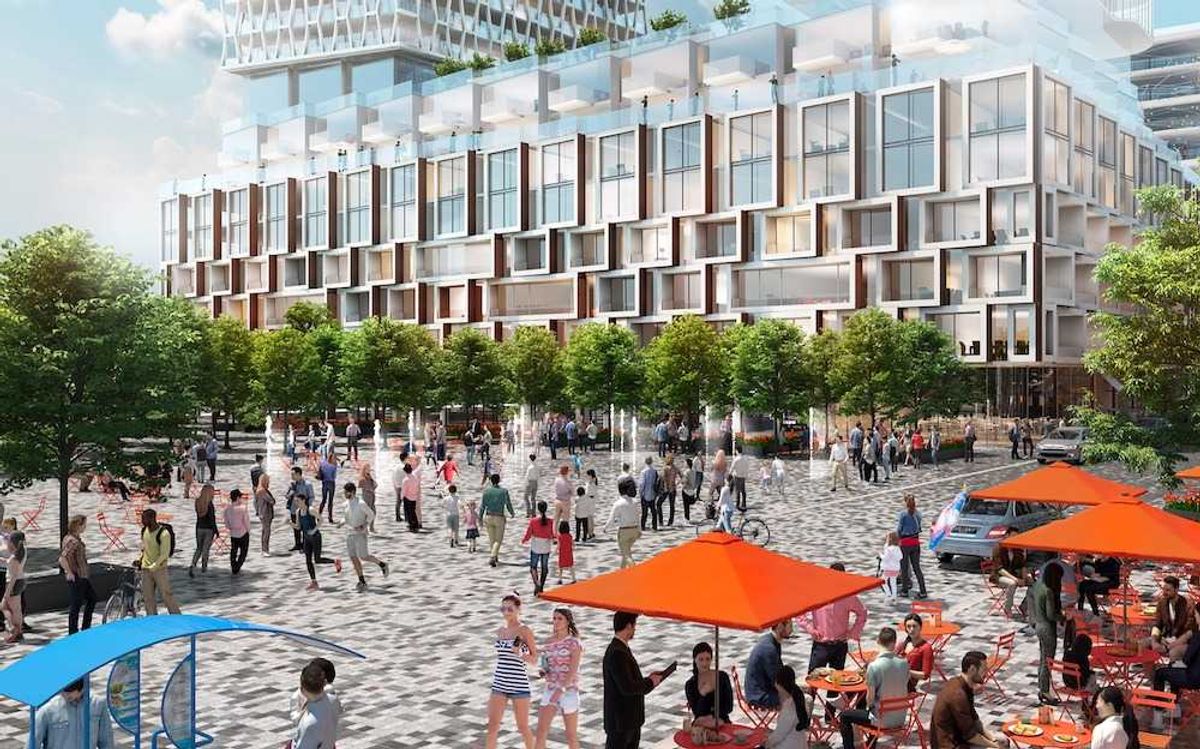
Cooper points to Dream’s new project at 49 Ontario Street in downtown Toronto as a prime example. Built in partnership with CentreCourt Developments, it’s a mixed income, purpose-built rental with a significant affordable housing portion. Earlier this year, Dream Impact Trust, the current owner of the redevelopment site, secured up to $647.6 million in government-affiliated financing and obtained waivers for development charges from the City of Toronto for the 800,000 sq. ft project. The development will feature 1,226 multi-family units, with 22% designated as affordable housing.
However, the industry shift isn't about abandoning the private sector. Bryan Reid, President of Vancouver’s Kindred Construction notes that Kindred aims to stay "appropriately spread" across both sectors. “While publicly funded work may have increased impact on being mission driven as far as non-market, social or affordable housing, the private side serves as critical of a function to continue to increase our housing stock across all levels of affordability, and own forms of tenancy and ownership,” says Reid.
Lean Design as a Financial Amenity
Alan Nicholson, Principal and Founding Partner at construction management firm MAKE Projects, gives his clients a dose of tough love: “Your project isn’t stalled; it’s overdesigned for today’s economics,” he says – plain and simple. “We tell them to either simplify the building and reset the proforma to something financeable, or stop spending money trying to resurrect a version of the project the market can’t build anymore. This usually means a deep cut that the project team has been avoiding.”
When it’s time to cut costs, it’s out with the flashy, in with the practical. Nicholson says that British Columbia’s construction development industry "grew fat" during the prosperous years and that 2026 is a necessary lean period. This means reconsidering the nice-to-haves.
“For most of 20 years, proformas could absorb a lot: architectural gestures, complex systems, overly bespoke detailing, and also policy enhancements around sustainability and accessibility, and increasing code requirements,” says Nicholson. “The fundamental underpinnings of rental rates, population growth, and amazingly consistent real estate value growth maintained the profitability of real estate investment. In 2024 and 2025, the fundamentals changed, and the ability to absorb disappeared.”
However, Nicholson highlights that policy doesn't retract quickly, if ever, calling construction material and labour pricing “notoriously sticky.” So, he advises clients to re-evaluate their design decisions; what used to be a necessary flashy extra may no longer be necessary (bye bye, theatre room).
Being fiscally responsible also means environmental considerations to avoid future carbon tax and operating costs. “We take a pragmatic approach to balancing carbon performance with financial discipline,” Cohen says of Daniels. “Our goal is to push low-carbon performance as far as possible while remaining responsible to our development partners and the long-term viability of each project.”
He says efficiency is key. “By focusing on building performance and reducing energy demand through better envelopes and smarter systems, we can remove inefficiencies elsewhere,” he says. “That creates room in the budget to invest in sustainability measures where the benefits are realized over time through lower operating costs and reduced risk.”
Daniels recently completed the first phase of Brampton’s MPV2 development, which utilizes geo-exchange and solar technology to lower long-term operating costs.
Taking Control: In-House Infrastructure
Vertical integration is often the best defence. In a climate of sky-high construction costs and labour shortages, it helps to have an in-house construction team. Those with an in-house construction arm aren't optimizing for a single phase of a project, rather, optimizing for the full lifecycle of buildings across their portfolio. Cupa says that this type of vertical integration gives Bosa Properties clarity and control.
“Because our construction team is part of the same organization, we’re able to make decisions earlier, design more efficiently, and adjust quickly when conditions change,” says Cupa. “That doesn’t mean we’re immune to cost pressures – no one is – but it does mean fewer surprises to project budgets or schedules. We can design with quality in mind, sequence work more strategically, and keep skilled trades consistently employed rather than cycling on and off projects. From a fiscal responsibility standpoint, that long-term lens matters.”
To further ensure execution certainty, Dream’s partnership with CentreCourt on 49 Ontario brings in a partner specifically known for self-performing construction at unmatched speed. This insulates the project from the scheduling delays that have notoriously plagued the GTHA.
Meanwhile, Daniels has recently brought strategic design and engineering oversight in-house and evolved its leadership structure to focus on construction as a service. Recently, it appointed its first Chief Construction Officer, Gokul Pisharoty. The expansion of their development management and construction management services will allow Daniels to build with and for others.
“This enables us to apply our expertise in complex, mixed-income and low-carbon projects while generating stable, fee-based revenue and supporting partners across the public, institutional, and non-profit sectors,” explains Cohen. “Together, these strategies reflect a disciplined approach to capital deployment; one that sustains housing supply, and aligns long-term financial stability with community impact, regardless of market cycles.”
The Path Forward: Innovation Through Repetition
Scaling building efficiencies for today's climate requires efficient repetition. Reid points to the Vienna House project in East Vancouver, which relies on prefab “clip-on” technology and mass timber, as a proving ground for industrialized construction.
“Innovation within the construction space takes repetition,” says Reid. "It will start slow, until it’s very quick.” He says that as these methods scale, the ability to do "more with less on-site labour" will eventually offset rising material costs.
Strategically navigating 2026 ultimately comes down to collaboration and speed. As Reid puts it, builders must invest in their clients' efforts early to find a path to viability. “Being efficient with schedules to avoid delays – as debt remains expensive and delays are very costly – is paramount,” he says.
Nicholson echoes the sentiment. “We always advocate for a tightly controlled project with good leadership, which will allow trimming of the budgets with tighter contingencies,” he says. “We cannot overstate the importance of this for cost control.”