There is no easy way to control consumer sentiment, macroeconomic conditions, or the cost of construction materials (let alone tariff threats from our neighbour), which is a big reason why the real estate industry has been so focused on development charges (DCs) in recent years.
Development charges are levied by governments on new construction, and are used to fund new infrastructure, under the premise that “growth pays for growth.” When the real estate market was strong, development charges were tolerable because homes could be sold for a high enough price to cover them.
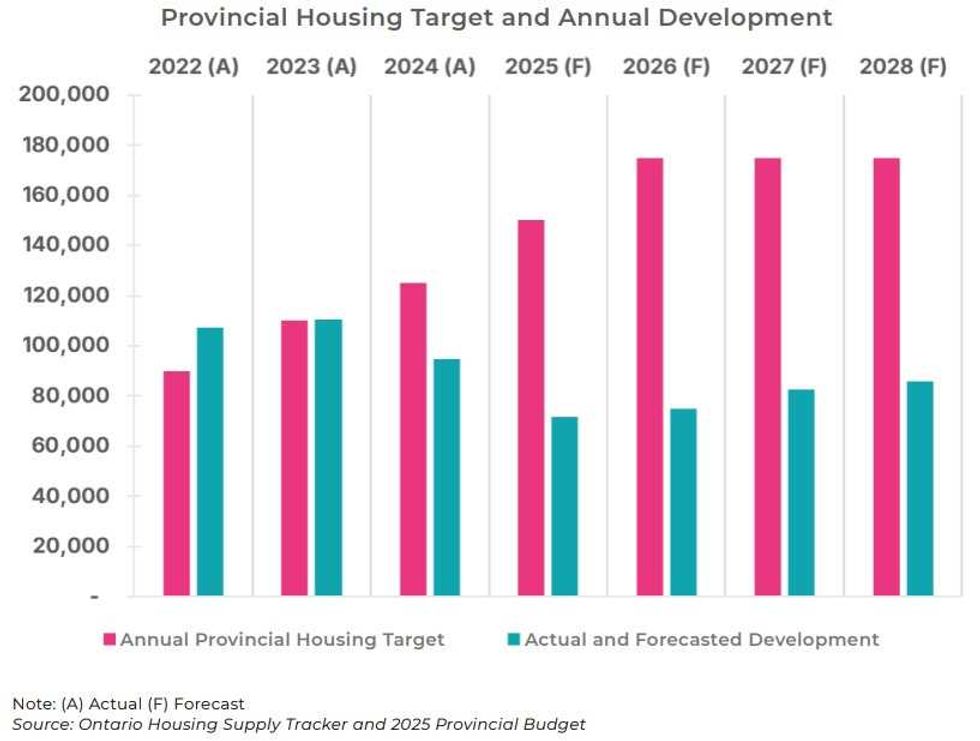
The market has turned, however; new development has slowed to a crawl, and housing starts are on the decline, meaning Ontario is facing an uphill battle in its goal to build 1.5 million new homes by 2031.
“DCs are not the sole cause of Ontario’s housing shortage, yet they remain one of the most direct levers available to reduce costs and accelerate construction without compromising fiscal responsibility,” said the Ontario Real Estate Association (OREA) in a report published last week. “The path forward is to simplify, standardize, and align the system so that housing and infrastructure are advanced together rather than set against one another.”
“Ontario’s DC framework has become a reflection of the province’s broader housing challenge. It is a system built with sound intentions that no longer functions in step with current realities. The mechanism designed to finance growth has shifted into one that too often prevents it. Reform is not about dismantling the principle that growth should pay for growth but about recalibrating how that principle is applied.”
As part of their report, entitled “A Pathway to Development Charge Reform,” OREA has outlined seven recommendations that would reform development charges, all without raising property taxes.
Provide immediate relief to homebuyers and accelerate housing construction through a two-year DC suspension program.
An immediate step that can be taken is for the provincial and federal government to establish a program that would provide municipal governments with targeted funding to temporarily eliminate development charges.
“Participation should be conditional on municipalities demonstrating that their annual DC-related capital expenditures exceed revenues during the suspension period to confirm that funds are being actively used rather than held in reserve,” said OREA.
“This measure would sustain construction employment, maintain infrastructure investment, stabilize municipal finances, and prevent Ontario’s housing downturn from deepening into a wider recession. It would also create the fiscal space needed to implement long-term DC reforms that support sustainable and affordable growth.”
Reducing infrastructure construction costs through the use of alternative financing mechanisms, such as MSCs and MUDs.
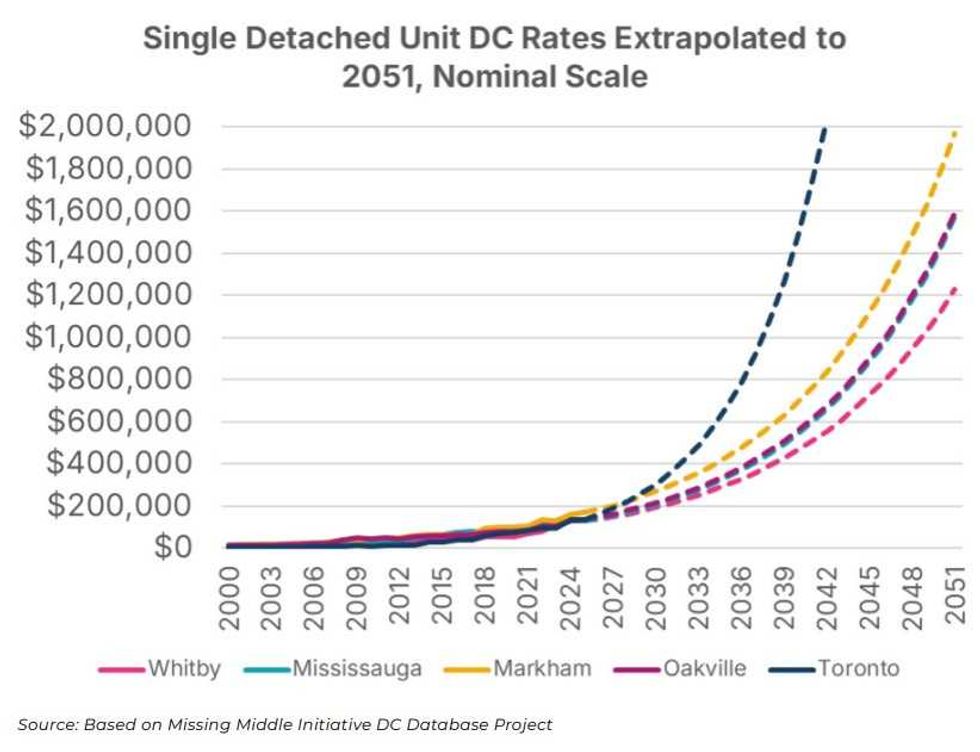
Provincially, the government should remove water and wastewater systems from the existing DC framework and enable alternative delivery/financing models through municipal service corporations (MSCs) and municipal utility districts (MUDs), which are already allowed under provincial legislation.
“Water and wastewater infrastructure represent some of the largest and most capital-intensive components of DCs,” said OREA in its report. “Requiring households to finance these costs upfront through their mortgages adds significant and unnecessary long-term interest burdens. This reform would lower long-term borrowing costs for households, reduce the need for builders to advance payments for municipal infrastructure, and promote specialized utility organizations that can efficiently plan and deliver essential growth-related services.”
 (OREA)
Implementing a transparent direct-to-buyer DC billing model that exempts DCs from HST and LTT.
As it stands today, developers pay DCs to governments upfront before later recovering the amounts after selling the homes. However, these upfront payments are largely carried on construction loans, which means they add to borrowing costs, accrue interest, and are later indirectly taxed through mechanisms like sales taxes and the land transfer tax (LTT).
“A direct-to-buyer model would fix this inefficiency by treating DCs the same way homebuilders already handle GST and HST,” said OREA. “The charge would appear as a separate, transparent line item on the purchase agreement, collected from the buyer and remitted directly to the municipality by the builder. It would be financed through the buyer’s mortgage rather than paid upfront like the LTT, while ensuring buyers contribute to infrastructure through long-term financing rather than additional out-of-pocket costs.”
Such a change would also allow governments to exempt DCs from the HST and LTT and eliminate the “tax-on-tax” effect that currently exists.
Removing population-growth related costs from DCs.
“Ontario’s DC system has drifted from its original purpose of supporting new housing infrastructure to supporting population growth,” the report states. “The costs it now funds stem largely from population increases shaped by provincial and federal policy decisions rather than by local housing construction. Municipalities are expected to recover these costs through fees applied only to new homes, leaving a small group of buyers to bear the financial weight of population-related decisions, even as the benefits of growth are shared by everyone both inside and outside the community.”
As such, the report recommends that community-wide services such as long-term care, childcare, and public health services be removed from the existing DC framework because they have little connection to the needs of new homes, and are of universal benefit. Also recommended is the creation of a performance-based funding model for population growth that ties funding to actual population growth, rewarding municipalities that see actual new homes built.
 (OREA)
Eliminating waste in the system and standardizing methodologies across municipalities.
The Ontario Real Estate Associate describes the existing DC framework as “increasingly opaque and inconsistent,” with many municipalities using “methodologies that are not standardized, inputs that are weakly justified, and project lists that include works that may never be delivered.”
Thus, DC rates can be reduced by tightening accountability and reducing waste through eliminating non-essential projects, removing automatic indexing (increases) of DCs, and standardizing assumptions for core inputs used in DC background studies that determine the capital costs of a project.
Improving support from senior governments and coordination between municipal capital works and provincial and federal infrastructure plans.
“Transit and road infrastructure account for some of the largest and most expensive components of DCs,” said OREA. “Many of these projects, including subway extensions and regional overpasses, generate economic benefits that extend far beyond municipal boundaries. Despite this, municipalities are often responsible for the planning and financing of this infrastructure.”
Instead, says OREA, all three levels of government should have a permanent coordination mechanism that would allow for shared planning and financing frameworks that could reduce duplication and create greater stability.
“This reform would provide predictable and shared investment for major growth-related infrastructure, reduce pressure on municipal DC rates, and enable projects to be delivered more efficiently and at lower cost to new homebuyers.”
Improve accountability and public trust by increasing transparency and reporting.
Towards more efficient use of DCs, OREA is also recommending the provincial government establish standardized transparency and disclosure requirements for DC reporting, as municipal treasurer statements currently vary widely in format and level of detail, making it difficult for the public, policymakers, and researchers to track the flow of funds.
To go even further, OREA says the provincial government could establish a DC Inspector’s Office with the authority to review municipal DC background studies, audit financial records, and intervene when irregularities or inefficiencies are identified, ensuring the efficient use of the billions collected from new housing.
The Ontario Real Estate Association’s “A Pathway to Development Charge Reform” report can be viewed in full here.