If 2025 was about waiting things out, 2026 is about finding out what still works.
Experts across development, construction, investment, and beyond say the real estate industry appears to be moving from pause to pressure-testing.
That shift is unfolding amid global volatility, evolving trade dynamics, and local conditions that continue to influence how capital is deployed and projects move forward. To get our bearings and provide context for the months ahead, the perspectives below reflect what industry leaders are seeing — and saying — as the year gets underway.
A Volatile Foundation
Ben Taddei, Partner and Chief Operating Officer at ConWest Developments, says volatility is his baseline assumption heading into 2026.
“High-level, I’m expecting a lot of volatility in the world. That’s going to materialize into uncertainty, which is going to cause people to pause.” Focusing on Vancouver specifically, Taddei points to a number of local pressures that he expects will continue to weigh on the market.
“The implications on Vancouver real estate are [that volatility], plus the micro factors." Factors, he explains, that will continue to be challenged throughout the year ahead, due to a lack of immigration — both nationwide and in British Columbia — alongside tight monetary policy, economic uncertainty related to Indigenous land rights, and a cost-of-delivery problem.
"All that means: another challenging year for real estate in Vancouver,” he says. Still, Taddei notes certain segments are showing resilience.
"What I'm seeing is a lot of activity in the large-format industrial sector. We’re seeing multiple offers on large buildings; that’s going to put upward pressure, shortly, on lease rates for those buildings. That’s an early indicator we might be approaching the bottom in that market. But residential, primarily, is going to be challenging.”
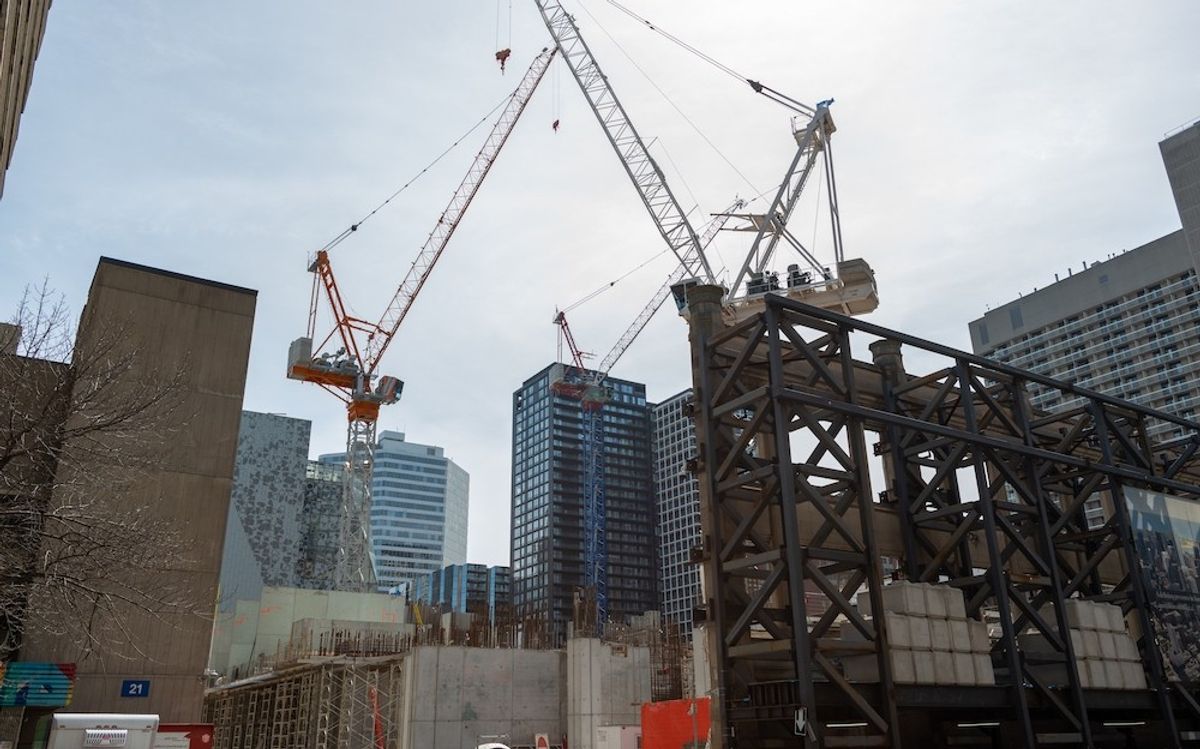
The slowdown Taddei describes has been especially visible for builders. Bryan Reid, President of Kindred Construction Ltd., says the stalling seen last year has carried forward into 2026.
“[In 2026, the] market [is] set for further disruption due to fiscal constraints faced by various levels of government," Reid says.
"While housing and infrastructure development is critically needed, the financial realities faced by projects that don't make sense (on the private side), and ballooning debt (on the public side) will likely see project starts pull back further in the near term. The focus on all projects will be cost-consciousness in order to make them as viable as possible, with other goals (green initiatives, innovation, etc.) that come with costs regrettably, likely, taking a back seat.”
The Reset: Capital, Costs, and Underwriting
From a planning and advisory standpoint, Kevin Hussey, President of Development & Construction at Pennyfarthing Homes, says sluggish presales have already forced a strategic reset.
“With presales slowing, developers have pivoted to rental at scale. In a low-immigration environment, absorption — not headline rent — has becomes one of the key variables. Substantial new supply will hit the market in 2026, and we expect that underwriting will shift from 'what are asking rents?'' to 'what are the effective rents after incentives, and how quickly can we lease up?'," Hussey says. "Near term, we expect more inducements, longer stabilization, and a tighter 2026–27 pro-forma as expectations reset ahead of healthier fundamentals in the next cycle.”
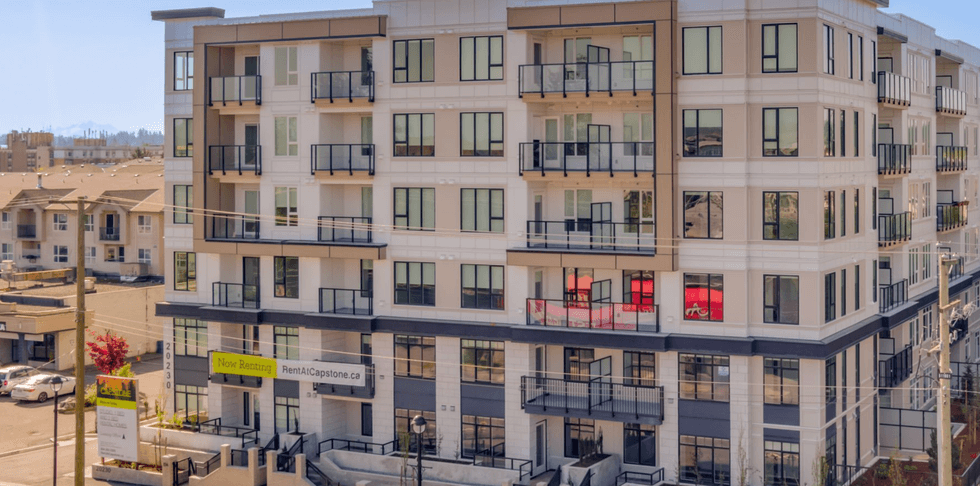 Pennyfarthing's The Capstone, Langley (pennyfarthinghomes.ca)
Meanwhile, David Basche, President of Astria Properties, notes that operating across British Columbia and Alberta has provided insight into how regional dynamics are diverging — particularly when it comes to capital deployment.
“The political uncertainty locally, coupled with [difficulty in] our regulatory environment from an entitlement perspective, has been dampening the market a lot," he says. "Of course, the Cowichan land claim issue is a looming cloud over British Columbia. And one of the biggest things we're seeing is that the big capital groups who are looking to invest in BC are treading very cautiously right now. That's obviously a big problem for our market, because we want to expand the industrial property base."
Basche explains that this carries over into other asset classes, too. "There are a lot of groups out here that raise capital through [those big capital partners], but these groups have, historically, also been active in acquiring, so that uncertainty affects not just us, from a development perspective, but also the capital partners. And then, more importantly, the businesses that are looking to expand in Vancouver." He notes, however, that these groups have shown strong leasing activity through Q4 and early 2025, signalling the start of normalization — but uncertainty remains with shifting activity south of the border.
"[Tariff escalations make] business really unpredictable," Basche says. "[Today,] most industrial businesses are acutely aware of what tariffs mean to their company and how they work. They know they're in place. Of course, the bigger issues is: are they changing? How fast are they changing? So hence why we're seeing a bit of a mixed decision making." He explains that while large companies have capacity for deep insight into tariff action, smaller organizations can struggle to keep up with quick and constant changes.
Conversely, Basche points to other market segments — particularly retail development — as being on the up as a post-COVID world continues to bloom. "We've seen great demand in retail for new developments," he says. "Those locations are incredibly hard to find, but if you have a location where you can build a grocery store with a drug anchor, a bank, and quick-serve restaurants, the capital is there. The tenants are there. The desire to execute from all other parties involved is there. It's been a really good business to be in, and we foresee that continuing to be really strong throughout 2026.”
In other words, things are undeniably moving again. But not everywhere, and not for everyone.
Selective Momentum
“After a couple of years dominated by rates and uncertainty, 2026 should be a year of cautious momentum," says Damon Conrad, Vice President & Head of Commercial, REMAX Canada. "Financing is becoming more workable bringing buyers and sellers back to the table, but it will be selective and quality led, with the best buildings and locations outperforming."
"Industrial is normalizing after an extraordinary run, retail has been more resilient than many expected, and office remains a tale of two markets, between space that fits how people work today, and space that needs a new plan," Conrad continues. "Activity should improve, but only where fundamentals and pricing align.”
Against that backdrop, there are also signs that the broader market may be nearing an inflection point. Diego Mandelbaum, Chief Development Officer at Corix, offers a cautiously optimistic view.
“In a world where uncertainty has become the only certainty, I expect 2026 to mark the beginning of a soft recovery — or at the very least, the end of the fall," Mandelbaum says. "I anticipate the wheat being separated from the chaff, with those hyper-focused on value and affordability beginning to bounce back, while those who aren’t continue to tread water. Even this fickle market is showing glimmers of hope that discipline may be rewarded again.”
At the residential level, early-year conditions remain subdued. Maryrose Coleman of Halloran & Associates, Sotheby’s International Realty Canada, points to broader global conditions and seasonal timing.
“With the continued geopolitical turmoil in the world, and being still early in the new year, the market remains quiet," she says. "I expect we will start to see more activity as we enter into February.”
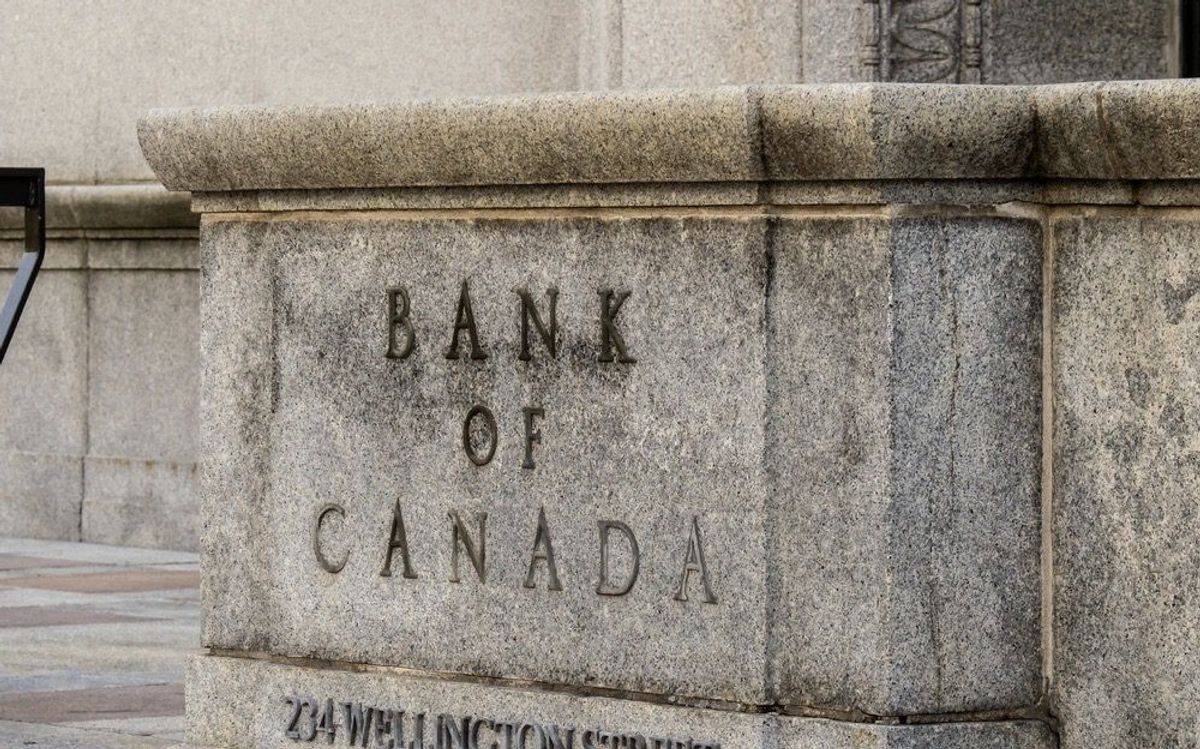
Coleman notes that national housing data from 2025 reflected a subdued market, with annual home sales declining to roughly 470,000 transactions and prices cooling modestly toward year-end. Interest rates were cut by the Bank of Canada in response to weaker demand; a move expected to support activity moving into spring 2026.
"I do expect prices to continue their downward trend for the near future," Coleman continues, "and for my clients considering selling, I encourage listing as soon as possible so as not to be chasing the market down. For buyers, this market offers some great opportunities."
Looking longer-term, Alan Nicholson, Principal and Founding Partner at MAKE Projects, frames the current environment as a necessary reset.
"Development and construction in the West — BC in particular — has had decades of prosperous growth. Many have grown fat off the land. This has bred complacency, inefficiency and ineptitude into our systems," he says. "Our systems, and our skillsets, supporting policy, regulation, development, and construction, are all generally less productive. This is reflected in the retracting Canadian GDP per capita since 2006."
"We need tough years; we need to lean out. Struggle makes us better. It is not easy or fun, but it is necessary," Nicholson continues. "So take heart my friends. See the moment for what it is — a necessary moment for resetting our foundation to allow for future years of returned prosperity. We will look back on these times as a distant memory where we learned to pivot, restructure, and innovate again. For me, 2026 is already filled with innovation and optimism."
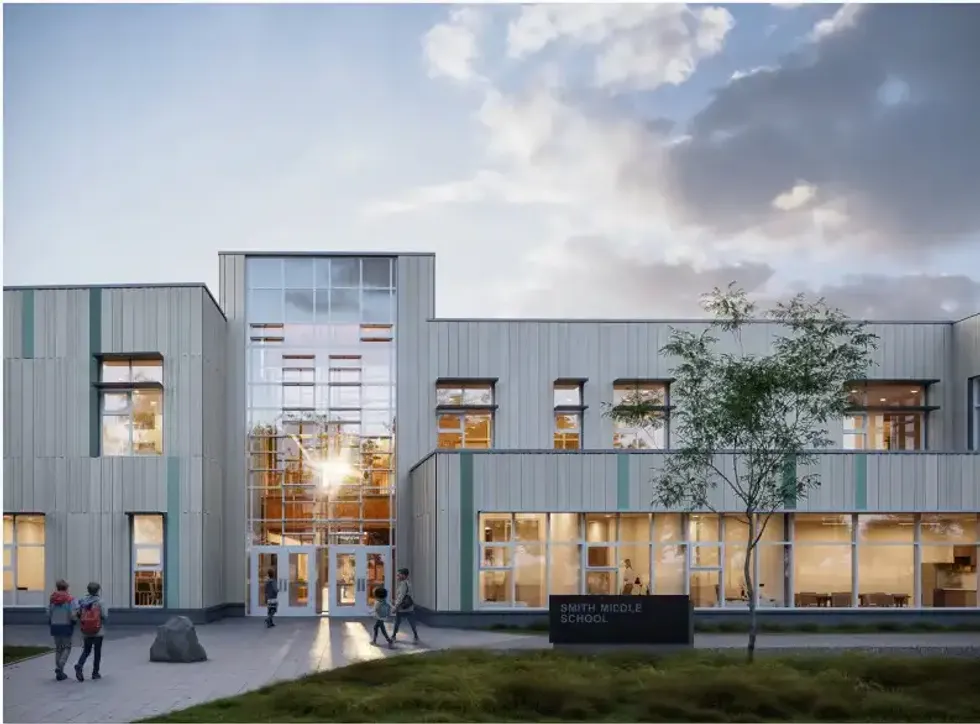 Rendering for MAKE Projects' Smith Campus Middle and Secondary School (makeprojects.ca)
For some developers, this reset is already translating into forward-moving momentum.
"2026 will be the year of recovery," says Rocky Sethi, Managing Director at STRYKE. "Water cooler talk will change from, 'I can't believe you are looking at buying,' to 'I can't believe you didn't buy that home!' . With sustained pressures on construction costs, and massive pent up demand, we will start seeing inventory being absorbed, and the market will find its footing this year and pricing pressure will increase late 2026/early 2027."
"Projects that provide community will be sought after, as they provide long term value and price appreciation," Sethi explains. "At STRYKE, we believe collaboration is the key to moving forward, and we are working with key partners to deliver housing. This will include private partners, not-for-profits, and Indigenous groups whose vision and values align with our own."
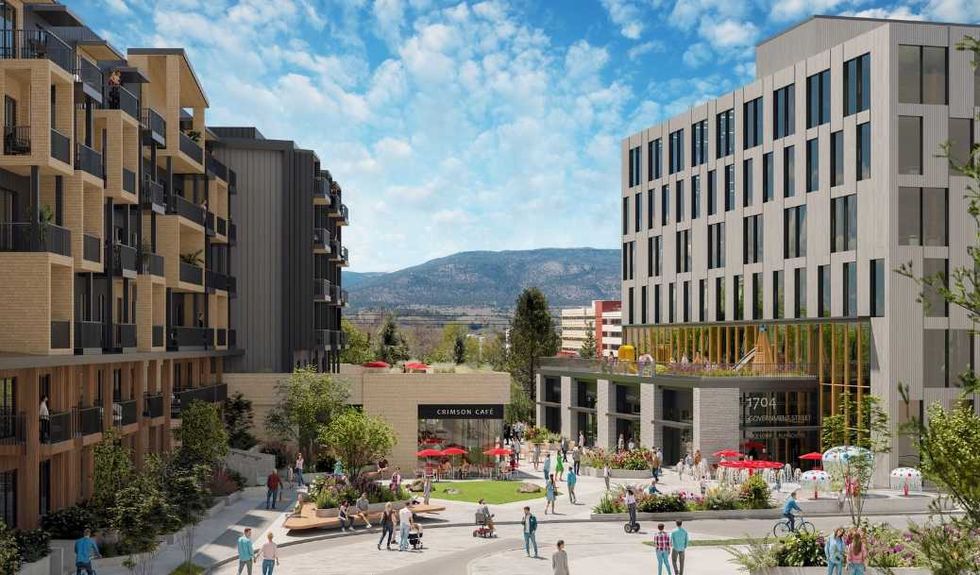 Rendering for STRYKE's Innovation District Master-Planned Community (innovationdistrict.ca)
Indeed, resilience is a resonant theme for those willing to face today's market challenges. Vice President of Construction for EDGAR Development Corporation, Adam Cochrane, speaks to this sentiment of adaptation and evolution.
"While the current market makes it tough to make projects work, at EDGAR we are embracing the opportunity to roll up our sleeves, sharpen our skills, re-think how we approach developments and find cost efficiencies," Cochrane says. "It’s more important now than ever for our consultant and construction partners have that same mindset; come up with better ways of doing things that help make our pro formas work."
The Macro Backdrop
Zooming out, 2026 is also taking shape against a clearly defined — if still highly conditional — monetary policy backdrop.
As the year gets underway, the Bank of Canada has eight fixed interest rate decision dates on the calendar, with announcements scheduled for January 28, March 18, April 29, June 10, July 15, September 2, October 28, and December 9. Monetary Policy Reports, including updated economic and inflation forecasts, will accompany the January, April, July, and October decisions.
Following a series of rate cuts in 2025 that brought the benchmark overnight rate to 2.25%, most major Canadian banks and economists have entered 2026 expecting the Bank to maintain a steady policy stance. Recent outlooks from RBC, TD, and CIBC have pointed to moderating inflation and slower economic growth as factors supporting a prolonged hold, while National Bank and Scotiabank have suggested that modest rate increases later in the year remain possible should economic conditions strengthen or inflation prove more persistent.
And of course, industry voices are closely watching how those dynamics play out in real time. "My projection is that rates would be held all year given the current setup," Daniel Foch, Chief Real Estate Officer at Valery.ca, told STOREYS this month. "But I expect the setup to change."
"I think Q4 2025 GDP data will read negative," he continued, "and Q1 2026 could as well, giving us a technical recession. I think unemployment will continue to rise, and inflation will continue to fall, and the Bank of Canada could have more runway to cut by the summer of this year."
For investors, builders, and borrowers alike, the months ahead are likely to hinge far less on any single rate decision and far more on how incoming economic data, geopolitical shifts, and on-the-ground realities reshape expectations, capacity, and what’s actually possible across the industry.
Time will tell. But for now, the prevailing 2026 sentiment is clear: it’s the Year of the Fire Horse, and while the industry isn’t galloping, it’s undeniably trotting — cautiously, deliberately, and with intention — toward what comes next.
______________________________________________________________________________________________________________________________
Did You Get All That? The TL;DR:
- 2026 is shaping up as a year of pressure-testing, not broad recovery — with activity returning selectively where fundamentals, pricing, and execution align.
- Volatility, capital caution, and cost constraints persist, but pockets of resilience are emerging across industrial, retail, rental, and fiscally responsible, quality-led projects.
- Interest rates matter, but on-the-ground realities — absorption, underwriting discipline, and demand — are increasingly driving decisions.
______________________________________________________________________________________________________________________________
For big stories like this one right to your inbox, sign up for our weekly newsletter.