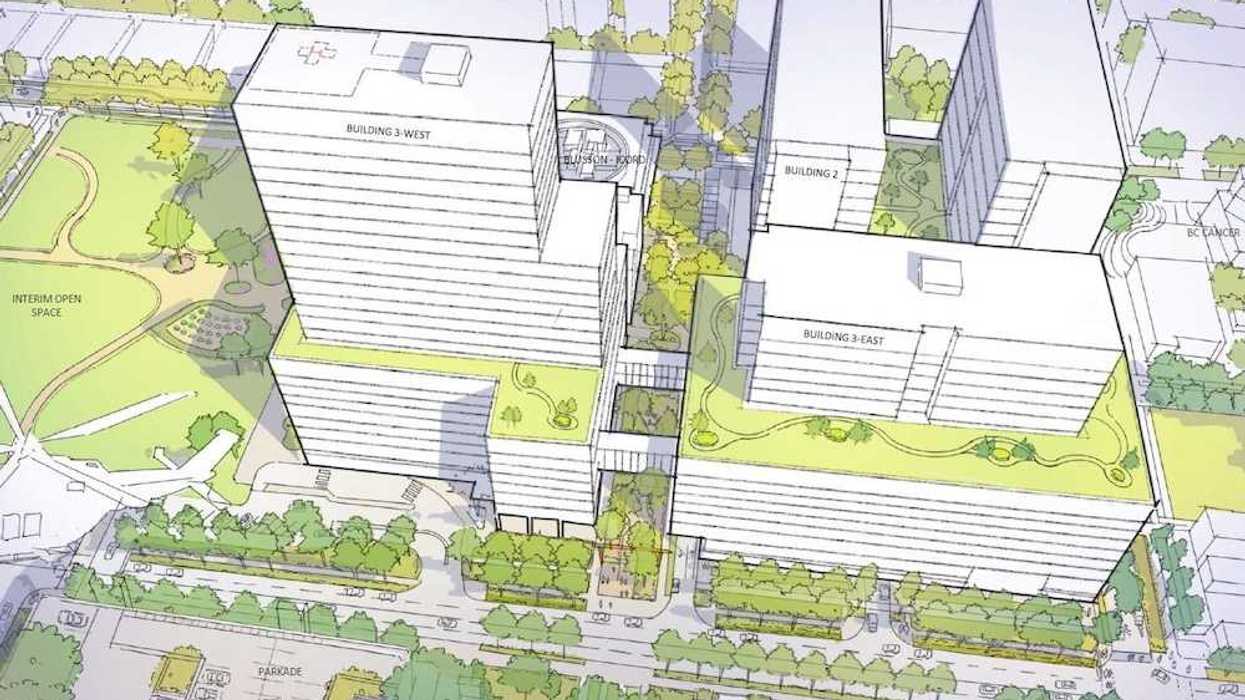
Last week, the City of Vancouver published a rezoning application that may have the biggest impact of any planned development project in the city: a 10-phase long-term redevelopment of the 35-acre Vancouver General Hospital (VGH) campus.
In a press release, Vancouver Coast Health (VCH) said the rezoning application “will enable the hospital campus to grow sustainability and continue to meet the evolving needs of patients, clients, staff, medical staff, and partners from across the province” and called it “an important first step in establishing a long-term planning framework for how the hospital campus could evolve to meet growing health-care demands and care delivery needs.”
The envisioned redevelopment serves as a framework for the revitalization of the campus, which is expected to take at at least 30 years and to be constructed across 10 carefully coordinated phases that will ensure VGH remains fully operational throughout. The campus rezoning application is akin to what other municipalities refer to as a master plan rezoning application, with construction phases to be guided by future development applications. Vancouver Coast Health would also need to secure approval and funding from the Province first.
Vancouver Coast Health is partnering with Kasian Architecture and Interior Design on the project and their rezoning application goes into great detail about the state of VGH and “an urgent public health crisis that requires an immediate response.”
According to VCH, bed shortages “create daily operational challenges,” delaying inpatient admissions from the Emergency Department, and demand is projected to surge over the next decade as the population of those aged 70+ is expected to grow 47% by 2035. The hospital's Emergency Department was built in the mid-70s, and 80% of inpatient beds are located in facilities built between 1953 and 1989. The local population — particularly in the Broadway Plan corridor, where VGH is located — is also expected to grow, and overall demand for healthcare is expected to follow.
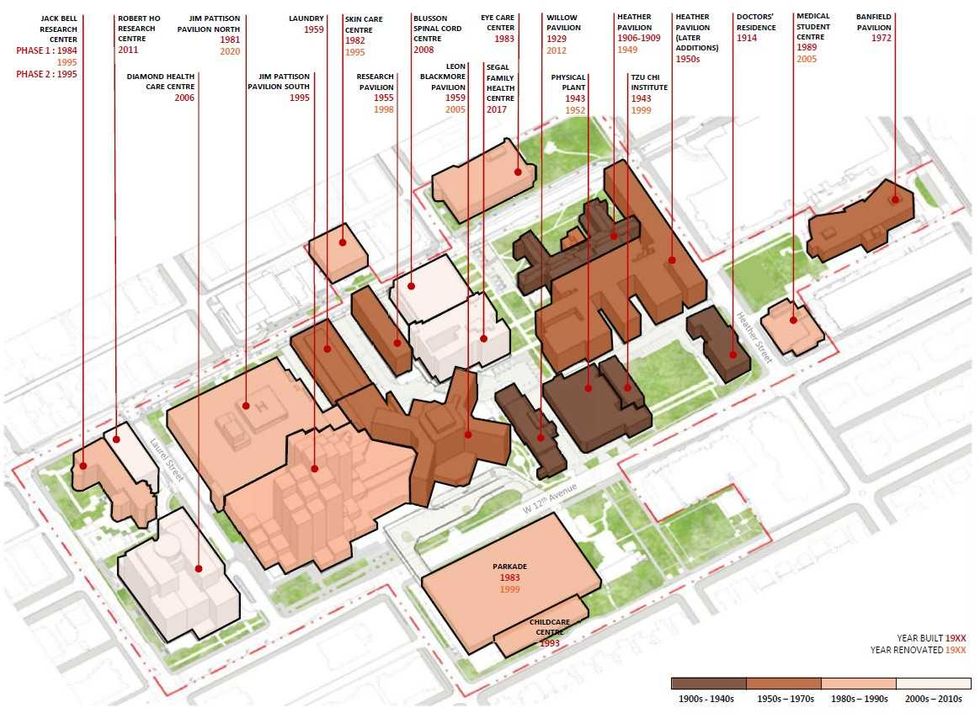 An overview of the Vancouver General Hospital campus and the ages of the buildings. (Kasian Architecture, Vancouver Coastal Health)
The VGH campus was rezoned in 2002, but “this framework no longer reflects the realities of redeveloping a large, land-locked hospital precinct into a modern, resilient, and sustainable health campus that evolves and expands with the community it serves,” the new application states, citing density constraints, height restrictions, and site coverage limitations as contributing factors.
“Given the limited land availability, future expansion must occur vertically, as horizontal sprawl is not feasible,” the application states. “As a result, the proposed new buildings will be taller and more space-efficient, contributing to an overall increase in campus density. […] A key principle of the plan is that new patient care facilities must be constructed and operational before older clinical buildings can be vacated and decommissioned.”
Over 300,000 sq. m — 3.2 million sq. ft — of modernized healthcare space in buildings up to 24 storeys is being proposed, with a maximum site density of approximately 5.0 FSR. (The VGH campus is currently around 2.43 FSR.) The rezoning application also proposes a suite of changes to things such as the zoning boundary, site coverage, open space requirements, heritage conservation requirements, and more.
The rezoning application provides a broad outline of all 10 phases, with the first phase to be focused on removal of non-clinicial buildings such as the Laundry Building, Research Pavilion, Heather Pavilion, Tzu Chi Building, and Doctors’ Residence. The application states that these buildings “can be temporarily relocated off-site without disrupting patient services.”
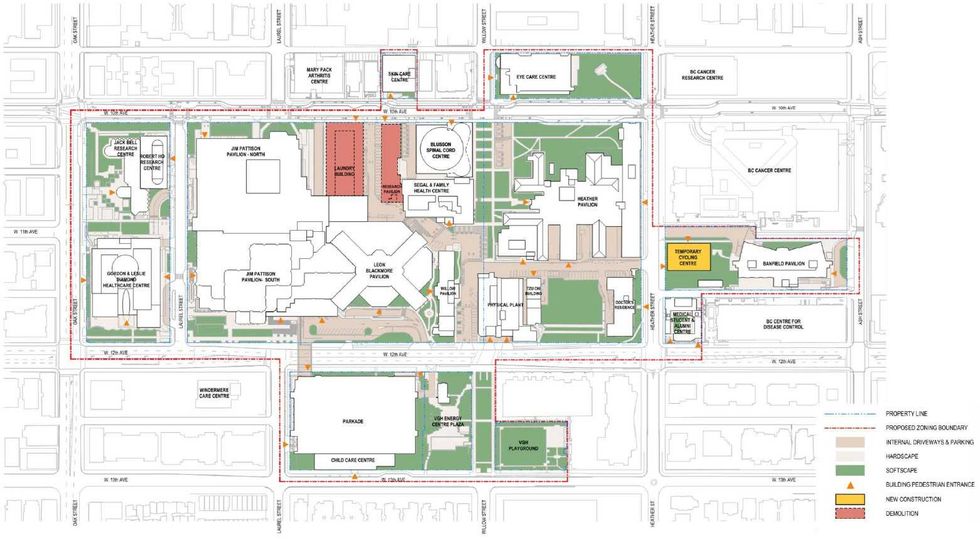 The existing VGH campus and Phase One plan. (Kasian Architecture, Vancouver Coastal Health)
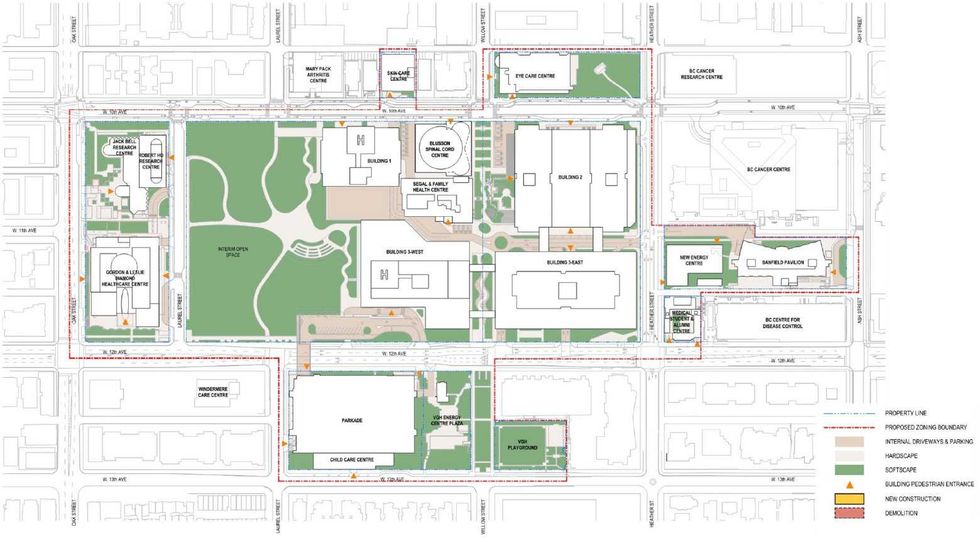 The layout of the new VGH campus after the 10-phase redevelopment. (Kasian Architecture, Vancouver Coastal Health)
Latter phases will then see the clinical buildings, such as the Leon Blackmore Pavilion and the Jim Pattison Pavilion, replaced — after new facilities are operational. Vancouver Coastal Health says there is currently a parking shortfall and that multi-level underground parkades will be included in three of the large new buildings to be constructed. The exact numbers have yet to be finalized, but the application states that 4,985 vehicle parking stalls would result in a surplus that ensures long-term adequacy. The number for bicycle parking is 925, not including short-term parking.
Each phase is also expected to include enhancements to the public realm that will “strengthen the identity of the campus, support intuitive wayfinding, and provide a meaningful connection to nature for all who use the site.” The rezoning application also states that the redevelopment plan “ensures that a baseline amount of open space is preserved permanently throughout all phases of development.”
In addition to the campus-wide rezoning application, VCH and Kasian have also submitted a rezoning text amendment application that would enable the first two phases. This application would be processed concurrently with the campus-wide rezoning and allows VCH to demolish the Laundry Building and Research Pavilion along West 10th Avenue, then construct a new 11-storey building (Building 1 in the image above) that would serve as an expansion of the Emergency Department currently located in the Jim Pattison Pavilion.
The City of Vancouver is holding the Q&A period for the campus-wide rezoning from Wednesday, February 11 to Tuesday, February 24, and an in-person information session has been scheduled for Wednesday, February 18 from 4:30 pm to 7:30 pm in the Paetzold Auditorium within the Jim Pattison Pavilion.
The application will then go to the Urban Design Panel on Wednesday, March 25.
Some enabling policy changes are expected to be considered by Council in Summer 2026, with consideration of the campus-wide rezoning to follow.