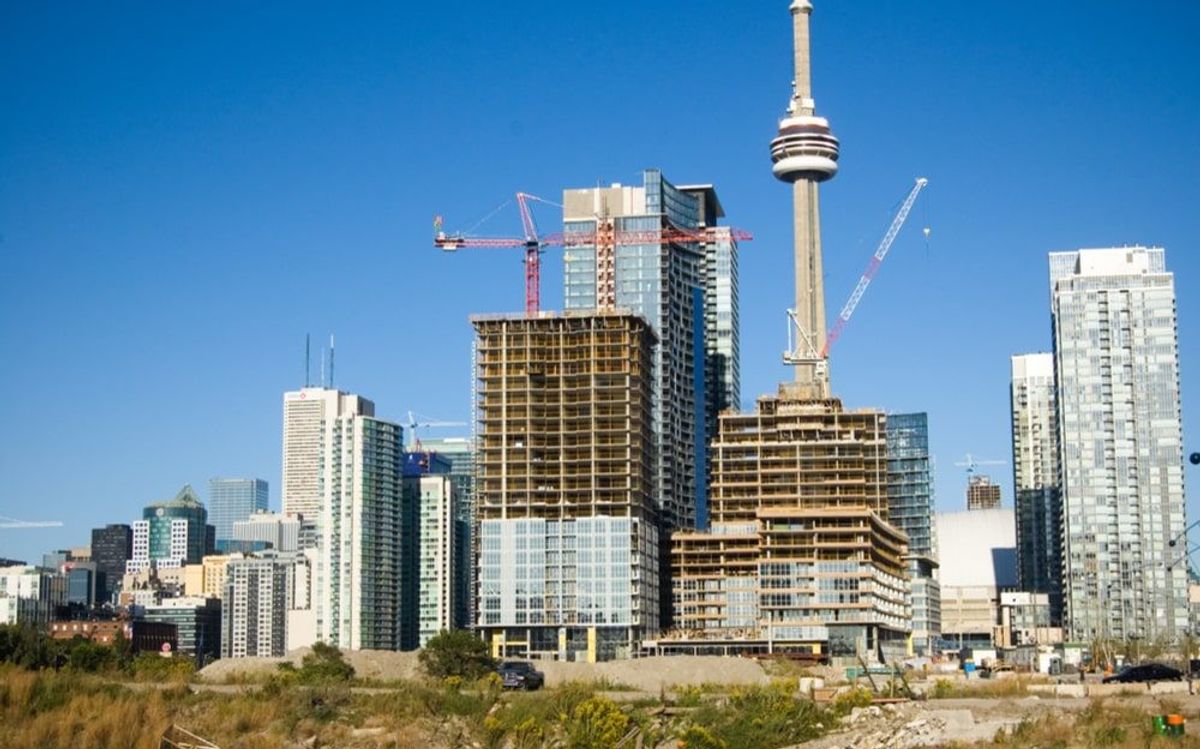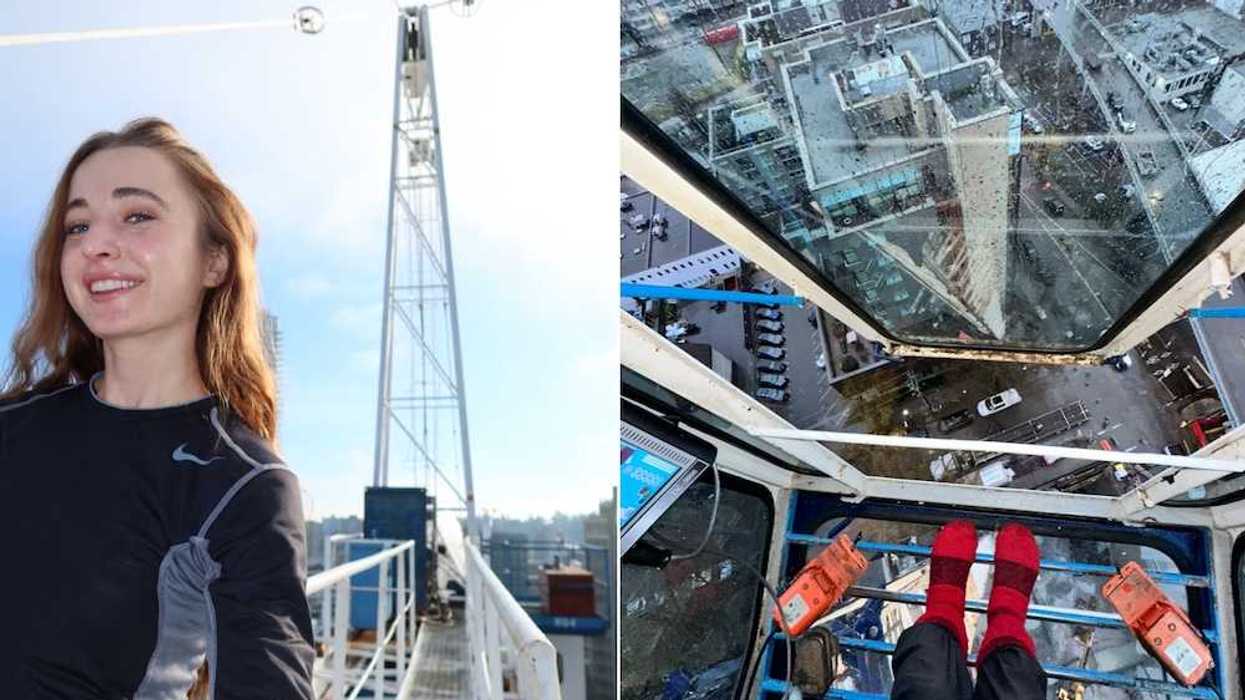
There are varying statistics and things are improving, but even so, women are estimated to represent just ~15% of the construction sector workforce in Canada. Any given construction site is home to a variety of people who play different roles, with one of the most important being the crane operator overlooking the site.
Statistics suggest that as few as 1 in 25 crane operators is a woman (that's ~4%). Manuela Preis is one of those ones.
Originally from Germany, Preis and her large family immigrated to Manitoba when she was around 8 years old. She went to university in Winnipeg for a year before moving out west to British Columbia four years ago.
Now 25, Preis has been a crane operator for over two years, and began documenting her job on Instagram.
In honour of Women In Construction Week and International Women’s Day, STOREYS caught up with Preis to dive into her unique job.
Responses have been lightly edited for length and clarity.
How did you get into construction?
I just kind of ended up there. I was originally in university, I was going to be an accountant, actually. COVID happened, everything went online, and online didn’t work well for me for school, so I decided to just put a pause on that.
I had a connection with oil and gas, my friend’s dad was a foreman, and a group of us decided to try it out just to make some money. It was only supposed to be a short-term thing, but I really liked it. It was fun. There was a lot of money, I think that’s definitely what kind of hooks you in. There was still a lot of work, and they didn’t shut down [because of COVID], so it seemed like a safe place.
How did you go from that to specifically being a crane operator?
I did oil and gas for three years; I started hopping on equipment, and then I was ready for a change because the work I was doing was up north and out of town, and I wanted the city experience. Out of nowhere, my friend — who knew I was in the trades — [got me in contact with someone who] started a crane company. He had two daughters, and he taught them how to run cranes, and they started a program where they were teaching other people how to run cranes.
So, I called him a bunch of times, he agreed to meet me, I drove out to Vancouver, we met for coffee, and then I started that process. That’s how I ended up in cranes. [For more details, there's a video about it.]
What was the training process like? How long did it take?
A lot of rules and regulations are [currently] changing for tower cranes. It used to be a lot different. You needed a specific number of hours. When I started, I don’t quite remember the number [of hours that was required], but it was fewer [than today].
Basically, you had a supervisor with you, you get your B Ticket, you get some rigging experience, and then you start collecting hours in the cranes with someone supervising. That’s how I started.
Do you typically stay with one project from beginning to end, or do you move around different projects?
A lot of times you do bounce around. Sometimes you do start-to-finish, but you just never know what happens with the project, right? [A] project that I was on…Basically, there was a disagreement, and it got put on hold. So you never really know.
My company does keep me busy. They’ll bounce me around until they find more of a permanent place. But then if you take time off, say, a couple months, then someone else will be taking over that permanent position, so you wouldn’t see that building through to the end. But if you stick around and everything goes according to plan, you should be able to do start-to-finish.
It also just depends on your experience, like if they want you to fly tables; you need to be a Red Seal operator to fly tables.
How would you describe the role crane operators play?
It takes a lot of mental work which, for me, is great. I like a busy brain. You pay attention to many things at the same time.
To me it’s almost like an art form, because in a way, you’re dealing with a pendulum. You have this big hoist line that you’re always trying to catch, so you have your trolley out, you have different gears, you’re doing different motions at the same time — you’re hoisting down with the load, you’re trolleying out, you’re swinging, and you want to keep that load as steady as possible, be smooth, and not too fast. You want it to be efficient.
Then you’re paying attention to everyone on the ground, what you’re flying over, as well as communicating with everyone, your rigger, and other equipment on site as well. So there’s a lot going on that you’re paying attention to.
You have a lot of roles; I don't think a lot of people realize what an operator does up there. There’s a system on how to keep your loads smooth and how to be efficient — especially getting into tight places — and making sure everyone feels safe around you. For me, that’s really important. I want the people that work under me to feel safe.
I wasn't aware of all the complexities of the job before seeing your videos.
There is [a lot of complexity]! Oftentimes your rigger pays attention to the rigging, but it’s also the operator’s responsibility as well, to see from the top if there’s something wrong with the rigging. You work as a team. The operator almost has the last say, like if you don’t feel like the load is safe, or it’s not safely rigged.
Also, the capacities are based on how far out can I go on my jib with this capacity. Some cranes will tell you how heavy a load is, but a lot of the older cranes, they don’t have any indicators like that. Usually, we do know how heavy something is, and then you do that calculation. There are a lot of different moving parts. [A recent video dove into crane capacities.]
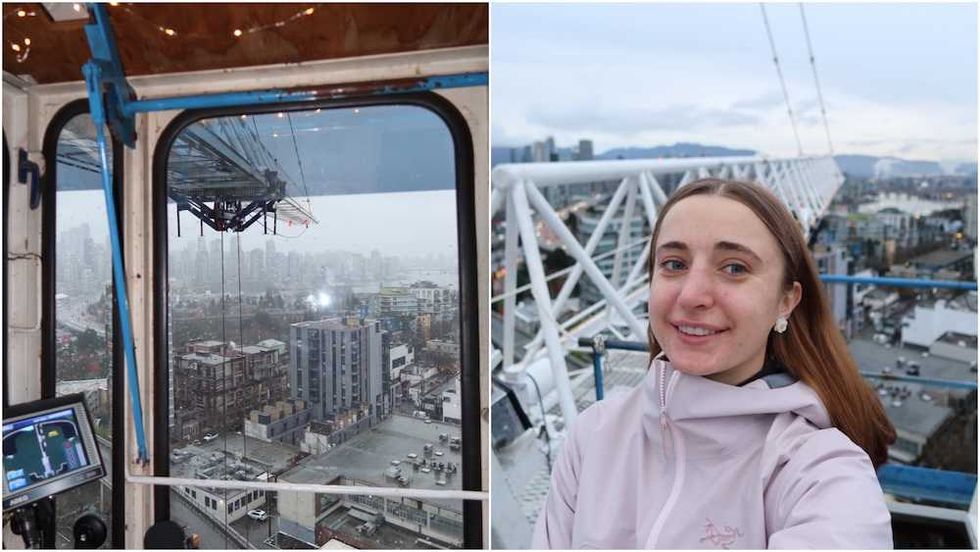 Manuela Preis/Instagram
What’s your day-to-day like? How much time do you spend atop your crane? Are you allowed to leave?
It depends on the job site. Some job sites, if it’s a smaller job, they’ll do eight or nine hours. Other job sites, a lot of times, you never really know when you’re getting off. You have an idea and then, all of a sudden, you’re there three more hours. Maybe we’re waiting on concrete trucks or a certain aspect of the job needs to get finished, because we’re trying to stick to schedule. During my weekdays, it’s always a gamble. I don’t try to make a lot of plans; if I do get off early, then I make plans then and there.
In terms of me climbing down … I’ve done it before: I try to squeeze in a quick appointment, I climb down really fast, I Uber to that appointment, and then I get back, climb my tower, and I'm back at work. Sometimes, you'll climb down if you want to grab a quick snack or you want to stretch your legs, but most of the time I stay up in my cab.
I think a cool thing that I haven’t shown [on Instagram] is, let’s say there’s a food truck that comes, or the rigger will say: “I’m going to 7-Eleven, do you want me to grab you something?” I’ll radio them and tell them if I want something, and then, I have a bucket with a rope that I let down from a counter-jib. They put in everything that I need, and then I pull that bucket up, so we don’t have to climb down.
How long does the full climb usually take?
It depends on how high up you are. Sometimes it’s a half-hour climb, if it’s a really tall crane. Other times it’s 15 minutes — because also while you’re climbing, you’re doing all your checks, you’re checking each tower section, you’re checking the bolts, you have a structural check every morning. So you want to be able to take a little bit of time to make sure that the crane structure is intact and all the bolts are tight.
So you’re pretty much in your cab all day, right? Some of your videos show that you pack your food, and even go to the bathroom in your cab?
Yes, everything is done in my cab.
[Manuela says the bathroom question is the most common question she gets, so she made a video about it.]
You talked about the weights and how it’s like a pendulum. How does the weather, like heavy wind, impact your job?
We are supposed to shut down at 50 km/h winds. If it’s getting to those higher gusts, your swing breaks might not hold the tower crane, which is very dangerous, because: Imagine you have a load that you’re hoisting, and then the wind grabs you. It can swing you without you having the capacity to swing back against the wind or lock your brakes. Past 50 km/h, the wind is strong enough to blow through your brakes.
We do have an anemometer up there, so I always know the wind speed. Once it gets too windy, I notify everybody and we try to wait it out.
You’re the one that notifies everybody?
Yeah, it’s the operator’s responsibility to let people know. And when you’re up there too, you are swinging against the wind. It’s harder to operate when it’s windy, so when it gets to 50 km/h, it’s really hard to keep everything steady and operating properly. You've gotta call it.
How often do you come across other women in construction? In general, and specifically with cranes? Is it proportional, or is it even rarer to see female crane operators?
I think it’s very rare. It just happened to be the company that I was with, and that he has two daughters that taught us how to run cranes. It’s very rare. Even when I was working oil and gas, I was always the only girl. It’s very normal for me; it’s never been a bother. I grew up with five brothers, so I was always around boys. I do have sisters as well, we’re a big family, but I grew up in between the boys, so me going into construction, it wasn’t a shock. It just felt like normal to be around a lot of men.
A lot of the men that I was working with are quite a bit older. I was always the youngest one. I would be 20, and the next-youngest person would be 35. And that would be young for construction in the oil field.
Even now, it’s hard to kind of run into people who are more my age — and you really don’t see a lot of women on site.
What’s the favourite part of your job? Any particularly notable days? What do you look forward to?
When I get up, I love going to work. I really like running cranes. I know a lot of people don’t feel that way, but I’ve never felt this way about a job before. I’m passionate about it. It’s very serious, there’s a lot of accountability, and I think I like that. I like being held accountable, I like having responsibility, and at the same time, it’s also kind of fun.
You kind of feel like a magician. You need to be really careful with this load, and you’re paying attention to so many things. You’re chatting with the guys on the radio, you’re joking back and forth, and you’re communicating in different ways. There’s a lot of fun characters that you meet. Every job you have, there are really awesome people.