You can have a development proposal for a beautiful building, or a financially-viable affordable rental project, or a sprawling transit-oriented mixed-use community, but you can’t do anything without support from lenders. So, knowing what lenders are thinking can go a long way.
Every year, CBRE Canada publishes an annual real estate lenders report, with this year’s survey — conducted between December 10 and January 16 — including 47 companies with an aggregate total of over $200 billion in loans under management. Lenders include domestic banks, private capital, foreign banks, pension funds, insurance companies, and credit unions.
Here are the big takeaways.
A Return To Office
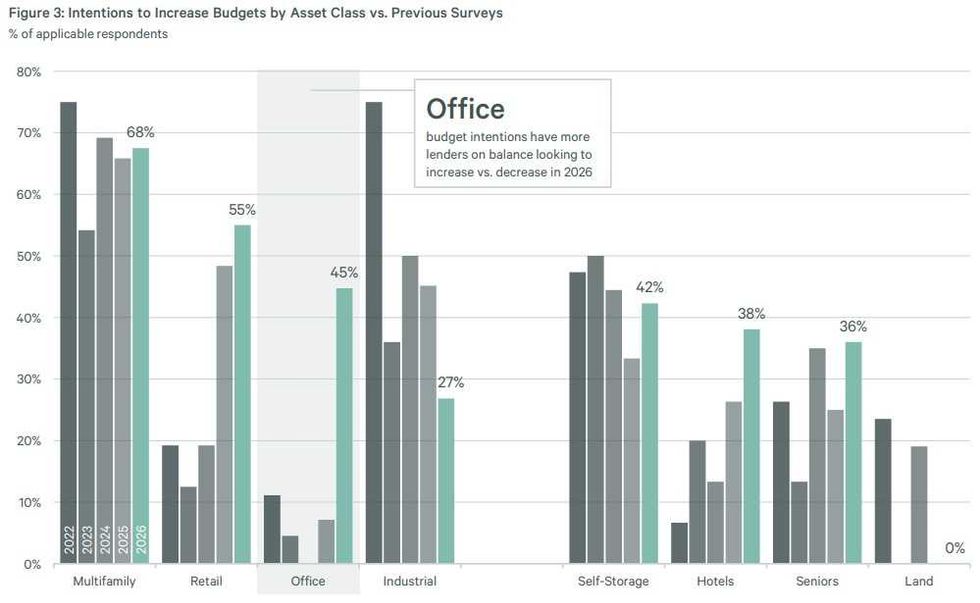
Employees are returning to the office, and lenders seem to be following suit. According to CBRE’s survey, lender intentions to increase budgets for office loans in 2026 have “surged” in 2026, a “rapid rebound in market sentiment” that represents the first rebound in six years.
This is not to say office is top asset class, however, as multifamily remains at the top, with lenders still showing intentions to increase budgets for that asset class. Lenders are also still looking to grow their exposure to retail, while industrial is trending in the opposite direction, although the sentiment isn’t nearly as poor as it is for land.
 CBRE Canada
It’s not all offices, however. Office lenders see aging / obsolete office product as a challenge and “are concerned about the significant investment required to modernize, amenitize or repurpose these properties to attract quality tenants.”
When it comes to office refinancing, lenders said they are most frequently granting short-term and long-term renewals upon maturity that result in increased loan proceeds for borrowers.
Vancouver Is Back On Top
As part of the annual survey, CBRE has respondents rank the different markets by lender appetite. For the first time in a decade, Vancouver is now the top market, overtaking Toronto, which is now second.
“After years of concentrating activity to Toronto, lenders could be looking to diversify their loan book and Vancouver stands out with strong property fundamentals across all asset classes,” said CBRE.
Third is now Calgary, which has jumped two spots since last year’s survey and overtaken Montreal and Ottawa. Edmonton has also been climbing the rankings the last few years, jumping four spots last year and one spot this year to sixth.
The biggest drop was Hamilton, which was sixth last year and has now dropped down to eleventh (out of fourteen). CBRE attributed the drop for Hamilton (and London) to industry-specific tariffs affecting the steel and auto sector.
The Challenges Are To Be Expected
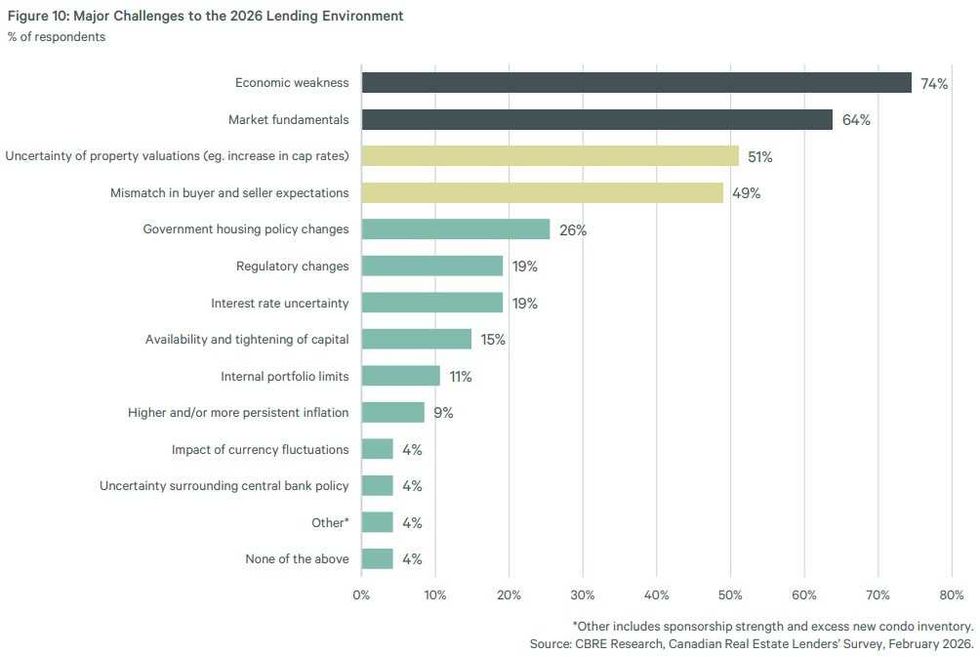
Less surprising is the top challenge in 2026, with 74% of respondents citing economic weakness as a major challenge, while 64% cited market fundaments, 51% pointed to the uncertainty around property valuations, and 49% highlighted the mismatch between buyer and seller expectations.
“The top two challenges to the 2026 lending environment are correlated concerns about economic weakness in Canada and how that might flow through to impact property market fundamentals,” said CBRE. “With GDP growth forecasts being revised lower for 2026, a weaker Canadian economy could drag on leasing momentum.”
 CBRE Canada
The next three challenges have all dropped significantly from last year’s survey. Government housing policy changes were cited by 30% of respondents last year, but 26% of respondents this year. Regulatory changes dropped from 27% to 19%, while interest rate uncertainty dropped from 41% — the fourth-highest concern last year — to just 19% this year.
“Notably, only a minority of lenders believe that the availability and tightening of capital will be a major concern in 2026,” CBRE pointed out, with just 15% pointing to it as a challenge.
More Lender Competition And Debt Liquidity
Survey results also saw 68% of respondents indicate that they will be “very actively bidding” or “actively bidding” for loans this year, with CBRE saying that the increased competition could result in tighter spreads and lower borrowing costs.
On the other side of the spectrum, only 15% said they were “cautiously bidding,” 13% described themselves as “conservatively bidding,” and just 4% said they have a “full hold on bidding” in 2026.
In addition to the increased competition, there is also expected to be greater debt liquidity, with 32% of respondents indicating plans to increase their origination volumes by 10% over last year. Over a quarter of lenders signaled intentions to increase their origination volume by 20% or more, with some saying 30% or more.
“The results from our 2026 Canadian Real Estate Lenders’ Survey show that real estate debt markets will be even more active this year as lenders look to deploy additional capital and ramp up competition,” said CBRE. “Outside of a handful of select property types that may face challenges, lenders are open and willing to finance most asset classes.”
CBRE’s 2026 Canadian Real Estate Lenders’ Report can be viewed in full here.