Ontario entered 2026 with the weakest housing conditions in the country, and Eric Lombardi believes that we can do better.
The 31-one-year old civic advocate is in the process of exploring a run for Ontario Liberal Leader, a slot that opened up after Bonnie Crombie announced her resignation in mid-January. The Party has said an election will be held in November.
If you have an ear to the ground of housing policy in Toronto, you may already know Lombardi’s name. The founder and former president of More Neighbours Toronto has made his pro-housing, YIMBY beliefs clear when speaking about ending exclusionary zoning and governments’ misguided attempts to curb housing speculation (amongst much more).
While Lombardi’s age is already a focal point in his exploratory run, he’s also part of a generation that’s felt the housing affordability crisis most acutely. And it’s not just housing he’s out to shake up, but education, healthcare, and the way critical infrastructure is delivered.
STOREYS checked in with Lombardi to find out how close he is to cementing his run, what his priorities are on Ontario’s housing file, and what he has to say to those that feel he’s too green for the job.
STOREYS: What prompted your interest in Liberal Party leadership?
Eric Lombardi: We need to have a greater debate about the future in Ontario, and I believe there is a path within the Ontario Liberal Party for a real change campaign. We get the rules for the campaign on Monday, and those will factor into whether or not I end up moving forward.
How likely do you think it is at this point that you will actually run?
It's more likely than likely. All the parts of the plane are being shipped in now, it hasn't been built yet, and so if I feel like the plane is in good condition for when the campaign starts, we'll move forward.
You’ve described yourself as a “finance and technology professional turned civic builder.” Is there something specific that prompted your interest in civic advocacy?
When it comes to housing, my fundamental belief is that it’s the most important so-called infrastructure for people's happiness. When people are happy with where they live, they tend to be satisfied with their life in other ways, and it’s more likely they're going to take on more responsibility, whether that's growing a family or starting a business. I think being content with where you live is of utmost importance.
When we look at what's happened in Ontario over the last 25 years, we've seen some of the worst per-person growth performances in all of Canada and the United States. And you’ve kind of covered up this underperformance and deindustrialization of the housing bubble, and it has really pulled the ladder on an entire generation, and now many young people wonder if they can build their lives here. To me, if you fix housing, you alleviate so many other problems that we're facing as a society, and defeat some of the cynicism that is built around the future of Ontario.
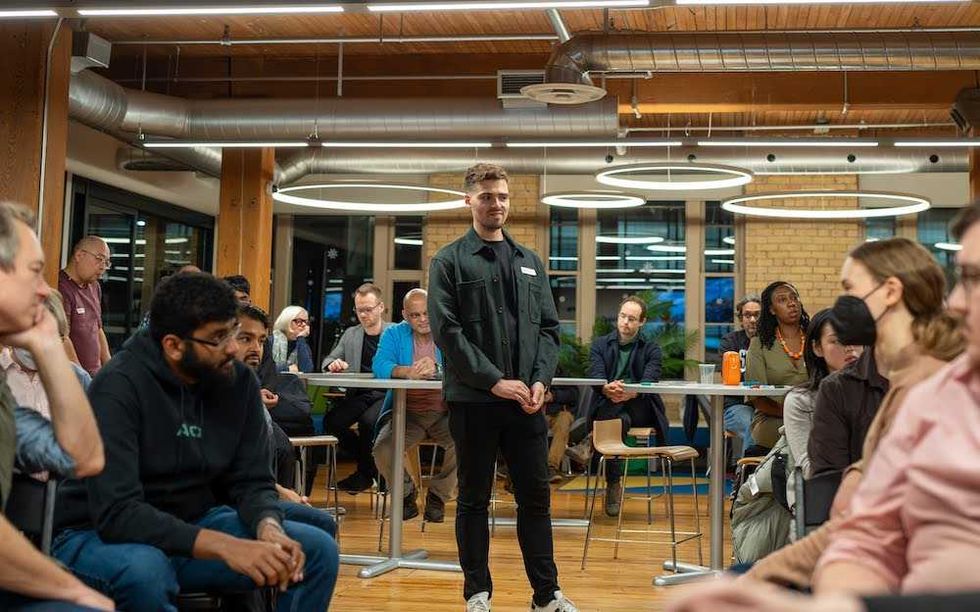 Eric Lombardi at an event for Build Toronto, which he chaired between September 2025 and January 2026.
As a housing advocate, what sorts of changes would you like to see made a priority?
I would like to see us fix the relationship between cities and the Province. Cities lack long-term capital funding for the infrastructure needs that they have, and we've seen an era of downloading of responsibilities that should be provincial to the municipality. And so, really putting that relationship on track for the long-term is quite important to me. Obviously, fixing our housing system, and our land-use and permitting system, is important, but so is our ability to create better institutions for delivering major infrastructure. Whether that infrastructure is transportation or major baseload power, the systems we have today raise costs beyond where they should be.
Also, our education system needs reform, and people are frustrated with health care. I think the solutions are simpler than people realize: we need to train more doctors, we need to train more nurses, and we're going to have to pay for additional capacity in the system so people are trained faster. When I look at the issues in Ontario, it's hard to look at anything that's going particularly well — and that's a shame, because we have every reason to be a prosperous and successful society, and we're not executing like it.
Why do you think we aren’t already looking at those "simpler" solutions?
Managing decline has been the story of Ontario, I think, since the Mike Harris era, and having a more positive-sum view on how important growth and productivity are for the long term, has been undervalued. What's going to be central to my campaign is putting forward this idea of a growth agenda for Ontario.
On that topic, how would you fight for housing growth without neglecting the reality that there is decline to manage?
We need to return the viability of a couple under the age of 30 being able to buy a first home suitable enough for them to start a family. The average mortgage affordability for a family in Ontario is about $500,000, which means that a family home in this province really needs to be around $650,000 for a young couple to be able to afford it. And I think it's actually entirely possible to restore this promise by addressing the new home taxes that we place on all new housing. I want to see us move to a model where 1% of the GST is given to cities, and we remove things like DCs and land transfer taxes, which, to me, are taxes on productivity.
You've spoken about how Canada is rooted in liberalism, but that the Liberals have lost the plot over the years. What do you believe is a truly Liberal approach to housing?
I believe we need to restore broader property rights so that it is viable to build the next increment of housing on most properties in Ontario. I think tax treatment needs to treat existing and new housing similarly. As a Liberal, I believe quite strongly in the value of competitive markets and creative destruction that drive productivity and investment. And those things are things that we can tax in order to provide generous welfare and excellent public services that we all want to have in a society that values opportunity. These are ultimately core Liberal values, and I think we've lost some of these principles when it comes to policy making.
Your age is already a focal point in your exploratory run. What do you say to those who feel you're too young to lead Ontario’s Liberal Party?
I think my age is an advantage more than a disadvantage. I also think the impact of policy over the last 30 to 40 years have largely fallen negatively on my generation and the one that's coming afterwards. So young people standing up and demanding a greater future than the one we're being given, is, frankly, incredibly important.
There is an appetite for generational change in how we do politics, and look, I'll put my record up against any of my competitors: I studied nanotechnology engineering and I know a lot about the technologies that are going to be impacting our society in the future; I've built a career in technology and financial services; and all the while, I've been contributing to the political discussion for years now through real and hard fought advocacy work. So yeah, I'm young, but I also think I have a lot to offer, and I believe Ontarians will meet that with an open mind.
Are you encountering many skeptics already?
Of course there are skeptics because I'm a bit of an outsider figure. Even though I have some relationship with the party, I am young and I'm not elected to a seat, so skepticism is fair, but I believe that I can prove a lot of skeptics wrong. I think the ideas that I'll be able to put forward will distinguish me as a credible candidate in this race.
Is there anything else you’d like to share with STOREYS readers?
Lombardi: My message is simple: Ontario can do much better. It should be doing much better. And there's no reason why the next 25 years need to feel like the stagnation of the last 25. We really need a mindset change in this province. We can lead the world, and that's going to be a central focus point of my campaign.
Questions and answers have been lightly edited for length and clarity.